
Energy Arbitrage with Battery Storage
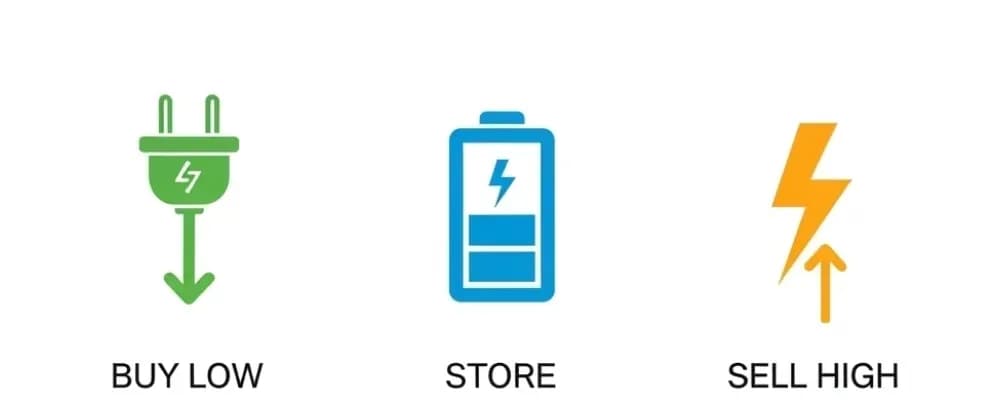
Buy low, sell high! This is he simplest revenue concept in energy storage, and the one most dependent on the EMS executing it. Here are the numbers from European Energy markets in 2025–2026.
Energy arbitrage is the practice of charging a battery when electricity is cheap and discharging it when electricity is expensive, capturing the price difference as profit. It is the most intuitive revenue stream in battery storage and, increasingly, one of the most significant. As European power markets absorb rising shares of solar and wind generation, the price spreads that arbitrage exploits have widened, and the granularity of trading has sharpened. This guide explains how arbitrage works, presents current market statistics from Germany and across Europe, examines the economics that determine profitability, and explains why the energy management system — not the battery — is the component that captures or forfeits the available margin.
What Energy Arbitrage Is
Arbitrage exploits the variation in electricity prices over the course of a day. Wholesale electricity is traded on spot markets where prices are set by the balance of supply and demand in each settlement period. When solar generation peaks at midday, supply is abundant and prices fall — sometimes below zero. When solar fades in the early evening while demand remains high, prices spike. A battery that charges during the midday trough and discharges during the evening peak captures the difference.
The mechanism is straightforward, but the execution is not. Capturing the spread requires forecasting prices accurately, deciding precisely when to charge and discharge, executing those decisions within the correct settlement windows, and doing so while respecting battery health constraints and any competing service obligations. These are the functions of the EMS. The battery stores energy; the EMS decides when that storage earns money. For the foundational role the EMS plays across all revenue streams, see the complete BESS EMS guide.
Day-Ahead, Intraday, and Continuous Markets
Arbitrage is executed across several market layers. The Day-Ahead market clears prices for each period of the following day in a single auction — in Germany, this auction sets prices for the next day at 12:00 CET. The Intraday auction allows positions to be adjusted closer to delivery. The Intraday continuous market operates in real time, matching buy and sell orders as they arrive, and exhibits the highest volatility — and therefore the widest arbitrage windows — of the three.
The most sophisticated arbitrage strategies trade across all three layers, buying in one market and selling in another to capture inter-market spreads. A battery might buy energy on the Day-Ahead market at a low price and, if the intraday continuous price rises sharply due to an unexpected weather change, sell that position at a substantial premium without ever physically dispatching. This inter-market trading multiplies the opportunities available to a well-managed asset — but only if the EMS and trading layer can execute across all markets simultaneously.
The Statistics: European Arbitrage in 2025–2026
The arbitrage opportunity is defined by price spreads. The following figures, drawn from European market data through 2025 and early 2026, illustrate the scale and direction of the opportunity.
Day-Ahead Price Spreads Are Widening
In the German Day-Ahead market, the average daily spread between the lowest and highest hourly prices reached €130.4/MWh across 2025, according to EPEX SPOT data. In individual months the spread ran far higher: October 2025 averaged €194/MWh between minimum and maximum hourly prices — the widest monthly differential since June of that year. On the intraday continuous market, evening-ramp spreads occasionally exceeded €440/MWh in ID3 auctions during the same period. These are the margins a battery captures, before efficiency losses and degradation costs.
Negative Prices Are Multiplying
Negative pricing — when generators pay consumers to take electricity — is the arbitrage operator’s ideal charging condition. In 2025, European day-ahead markets recorded approximately 575 hours of negative prices in Germany alone, up from 457 in 2024 and 301 in 2023. The record low on the German day-ahead market reached roughly –€250/MWh on 11 May 2025, during a high-solar midday period. During negative-price hours, a battery is effectively paid to charge — turning the cost side of the arbitrage equation into additional revenue.
Quarter-Hourly Trading Sharpened the Signal
In October 2025, the German Day-Ahead market transitioned from hourly to quarter-hourly (15-minute) settlement, clearing next-day prices in 96 fifteen-minute blocks. Analysis by Rystad Energy found that this finer granularity unlocked roughly 14% additional arbitrage potential compared to hourly intervals — because short price spikes lasting only one or two quarter-hours, previously hidden inside hourly averages, became individually tradeable. This change directly rewards EMS platforms capable of high temporal precision: an EMS that can only act on hourly blocks cannot capture the 15-minute spikes that now carry a meaningful share of the arbitrage value.
Revenue Per Megawatt
Translating spreads into revenue, the Enervis BESS Index reported average monthly revenues of approximately €12,000 per MW for German battery storage, rising above €25,000 per MW during summer months. Benchmark simulations for October 2025 placed combined spot-market strategies (Day-Ahead plus intraday, coordinated) at around €14,500 per MW for the month, with isolated single-market strategies earning materially less. The gap between the coordinated and isolated figures is the value the EMS adds through multi-market execution.
Statistic in Focus: Why Multi-Market Coordination Outperforms
October 2025 benchmark data showed isolated spot strategies earning €7.6k–€11.8k per MW, while a coordinated strategy across Day-Ahead, intraday auction, and continuous trading reached €14.5k per MW — a 20–90% uplift from the same hardware. The difference is not the battery. It is the optimisation engine deciding, continuously, which market offers the best return for each unit of available capacity. An asset locked to a single market by an inflexible EMS leaves the coordination premium on the table every single day.
The Economics: What Determines Arbitrage Profitability
Not every price spread is worth capturing. Three factors determine whether a given arbitrage cycle generates net profit, and the EMS must weigh all three in real time before dispatching.
Round-Trip Efficiency
A battery loses energy on every cycle. With a round-trip efficiency of around 90% — typical for lithium-ion systems — a battery that buys electricity at €100/MWh must sell at approximately €111/MWh just to break even on the energy lost in charging and discharging. The EMS must factor this efficiency threshold into every dispatch decision: a spread that looks profitable on paper may be a net loss after conversion losses. For the relationship between efficiency and utilisation, see PowerKonnekt’s analysis of capacity factor and round-trip efficiency.
Degradation Cost Per Cycle
Every charge-discharge cycle consumes a fraction of the battery’s finite cycle life. If a battery rated for 10,000 cycles costs €200/kWh to refurbish, each cycle carries a degradation cost of roughly €20/MWh. An arbitrage spread must exceed both the efficiency loss and this degradation cost to generate true profit. The EMS’s lifecycle-aware optimisation is what enforces this discipline: it declines marginal spreads that would cost more in degradation than they earn in margin, preserving battery life for higher-value windows.
Forecasting Accuracy
Arbitrage decisions are made in advance, based on forecast prices. If the forecast is wrong, the battery may charge expecting a high evening peak that does not materialise, or miss a spike it failed to predict. Forecasting accuracy directly determines realised revenue. An EMS with an integrated forecasting suite — covering price, solar generation, wind generation, and load — makes better dispatch decisions than one trading on naive assumptions, and the revenue difference compounds across every cycle of every day.
Arbitrage at C&I Scale vs. Utility Scale
Arbitrage applies differently depending on the size and context of the asset.
At utility scale, standalone BESS assets trade directly into wholesale markets, often through a professional energy trader or trading platform. The arbitrage strategy is the primary or co-primary revenue stream, stacked alongside frequency regulation and capacity payments. The scale justifies dedicated trading integration and sophisticated multi-market optimisation.
At commercial and industrial scale, arbitrage typically takes the form of time-of-use optimisation: charging the battery during low-tariff periods and discharging during high-tariff periods to reduce the facility’s energy bill. Under the EU’s dynamic tariff framework — enabled by Directive 2019/944, which requires suppliers serving large customer bases to offer dynamic contracts — a C&I battery can arbitrage wholesale price variation directly. Estimates place the pure arbitrage value at roughly €62 per kWh of usable battery capacity per year on a German dynamic tariff in 2025, on top of any solar self-consumption savings. This stacks with the peak-shaving value covered in PowerKonnekt’s peak shaving guide.
Why Arbitrage Revenue Depends on the EMS, Not the Battery
The battery is a passive store of energy. Identical battery hardware, deployed in the same market, will generate dramatically different arbitrage revenue depending on the EMS that controls it. Three EMS capabilities determine the outcome.
Multi-market execution. An EMS that trades across Day-Ahead, intraday auction, and continuous markets simultaneously captures the coordination premium that single-market operation forfeits — the 20–90% uplift the October 2025 benchmarks demonstrated.
Temporal precision. With quarter-hourly settlement now live, an EMS must act on 15-minute windows to capture the short spikes that carry a growing share of arbitrage value. Hourly-resolution dispatch leaves that 14% on the table.
Constraint-aware optimisation. The EMS must arbitrage within the boundaries set by round-trip efficiency, degradation cost, state-of-charge limits, and any competing service obligations such as frequency regulation reserves. An EMS that optimises arbitrage in isolation — ignoring degradation or starving a frequency regulation commitment of its reserve — generates apparent profit that is eroded by hidden costs elsewhere.
This is also where the boundary between the EMS and the trading layer matters. The EMS executes physical dispatch and enforces the asset’s operational constraints; the trading platform makes the market decisions and submits the bids. The two must integrate seamlessly — the trading layer’s decisions are only as good as the EMS’s ability to execute them within the asset’s real limits. For how PowerKonnekt coordinates fleet-wide arbitrage across multiple sites, see the VPP and aggregation guide.
Frequently Asked Questions
What is energy arbitrage in battery storage?
Energy arbitrage is charging a battery when electricity prices are low and discharging it when prices are high, capturing the price difference as profit. It is executed across Day-Ahead, intraday, and continuous wholesale markets, and at C&I scale it takes the form of time-of-use optimisation against dynamic electricity tariffs.
How much can a battery earn from arbitrage?
Revenue varies by market, season, and strategy. In Germany during 2025, battery storage earned average monthly revenues of around €12,000 per MW, rising above €25,000 per MW in summer months. Coordinated multi-market spot strategies reached roughly €14,500 per MW in October 2025 benchmarks. At C&I scale, dynamic-tariff arbitrage was estimated at around €62 per kWh of usable capacity per year.
What price spread does arbitrage need to be profitable?
A spread must exceed both the round-trip efficiency loss and the degradation cost per cycle. With 90% efficiency, a battery buying at €100/MWh needs to sell at about €111/MWh just to cover energy losses. Adding a degradation cost of roughly €20/MWh per cycle, the spread must comfortably exceed these thresholds before a cycle generates net profit. The EMS enforces this discipline automatically.
Does quarter-hourly trading change arbitrage?
Yes. The German Day-Ahead market moved to 15-minute settlement in October 2025, unlocking an estimated 14% additional arbitrage potential by making short price spikes individually tradeable. This rewards EMS platforms that can act on 15-minute windows and penalises those limited to hourly-resolution dispatch.
Can a battery do arbitrage and frequency regulation at the same time?
Yes, subject to state-of-charge management. The EMS reserves the capacity required for frequency regulation commitments and arbitrages the remaining headroom, recalculating the arbitrage schedule in real time as frequency activations consume energy. Stacking these revenue streams from a single asset is a core function of an advanced EMS and materially improves project economics.
What is the difference between arbitrage and peak shaving?
Arbitrage targets the energy component of value — buying cheap and selling dear across wholesale markets or tariff periods. Peak shaving targets the demand component — preventing a facility’s maximum power draw from registering at the meter to reduce demand charges. Both can run simultaneously under one EMS, with the demand-charge constraint taking priority and arbitrage operating within the remaining capacity.
How PowerKonnekt Approaches This
Automated energy trading is a native function of the PowerKonnekt EMS. The platform executes algorithm-driven “buy low, sell high” dispatch around the clock, integrating directly with Day-Ahead, Intraday, and Balancing markets, and connecting to trading platforms such as SmartPulse via REST API. The forecasting suite — covering PV, wind, load, and price — feeds the optimisation engine, which plans state of charge, smooths renewable output, and operates with full lifecycle awareness so that marginal spreads are declined when degradation cost would exceed the captured margin.
PowerKonnekt’s arbitrage capability is amplified by its relationship with Capaloai, its sister company specialising in energy trading and market optimisation. PowerKonnekt provides the EMS dispatch layer — the millisecond-level control that executes trades within the asset’s physical and contractual limits — while Capaloai provides the trading intelligence that decides which positions to take across markets. This division mirrors the structure of the most sophisticated storage operations: a control layer and a trading layer, integrated but specialised. Competitors offering only one of these layers cannot match the combined capability.
Deployed assets demonstrate arbitrage in operation. The Ege RES BESS (20 MW / 26.5 MWh, İzmir) runs trading platform integration alongside PPC functions. The FCR-N deployment in Finland combines grid-code-compliant frequency response with arbitrage based on dynamic market prices and time-of-use optimisation — stacking ancillary revenue and energy arbitrage from the same battery. Across the Romanian and Hungarian portfolio, self-consumption and arbitrage strategies run under the same EMS that manages standard dispatch and renewable integration.