
Power Grid Frequency Regulation
In today’s rapidly evolving energy landscape, the integration of renewable energy sources and the need for a more resilient power grid are paramount.
A battery energy storage system connects to the grid, stores and releases electricity, and earns revenue from the services it provides. That description is accurate and entirely insufficient. The commercial case and the operational value of a BESS depend on which grid services it can deliver, how well it delivers them, and whether it can sustain multiple services simultaneously without degrading performance on any single one.
Three capabilities define the range: frequency regulation, which earns revenue from the speed of response; black start capability, which delivers resilience when the grid cannot sustain itself; and capacity factor, which measures how efficiently the asset converts its installed capacity into actual throughput and income. Together, these three services represent the full spectrum of value a BESS can provide — from millisecond-level frequency response to the strategic utilisation decisions that determine long-term financial returns.
This guide covers what each service involves, what the EMS must do to deliver it, how the three interact in practice, and why the relationship between them determines whether a BESS is a productive grid asset or an underutilised capital expenditure.
Frequency Regulation: Revenue From Speed
Power grid frequency — 50 Hz in Europe and most of the world, 60 Hz in North America — is the real-time indicator of balance between generation and consumption. When generation exceeds demand, frequency rises. When demand exceeds generation, frequency falls. Frequency regulation services exist to arrest deviations before they reach the thresholds at which protection relays disconnect generation and load.
Battery storage has a structural speed advantage in this market. A gas turbine reaching full power from standby takes minutes. A well-configured BESS reaches contracted power within seconds — in the case of Frequency Containment Reserve (FCR), the full response must be delivered within 30 seconds of the triggering event. For secondary frequency control (aFRR), the EMS must track a reference signal from the transmission system operator and adjust power output every four seconds, sustained across the entire activation window. Deviation from the reference signal is penalised, making EMS tracking accuracy a direct revenue variable.
The EMS architecture that delivers this performance operates at timescales far below what human operators or supervisory monitoring platforms can manage. Frequency is measured continuously — using precision energy analysers sampling at 3-millisecond intervals — and the EMS control loop completes a full cycle of data acquisition, decision computation, and setpoint transmission to the Power Conversion System every 20 milliseconds. Fifty complete cycles per second, each one a closed-loop control action. This is not a feature that can be added later through a software update if the measurement hardware and control architecture were not designed for it from commissioning.
Frequency regulation revenue in European markets is primarily structured as a capacity payment — paid per MW of contracted availability per week — with an energy component payable on actual activation. In Germany, FCR capacity has cleared at €8–24 per MW per week through 2024–2025. The specific revenue outcome for any individual BESS depends on market conditions, the asset's prequalification status, and the EMS's ability to sustain performance scores that avoid penalty deductions.

Black Start Capability: Resilience When the Grid Cannot Sustain Itself
Black start is the ability to restore a power grid from a complete shutdown without relying on external electrical supply. Following a total blackout — whether caused by cascading failure, severe weather, or infrastructure damage — the grid has no voltage, no frequency, and no reference for generation to synchronize to. Restoring service requires at least one resource capable of establishing that reference from nothing.
Historically, black start capability was provided by specific hydro plants and gas turbines equipped with self-start diesel generators. These assets could energize a local section of the grid, establish a voltage and frequency reference, and allow other generation to synchronize progressively until the system was restored. The process was slow, manual, and dependent on assets that were often located far from the areas of highest demand.
Battery storage with grid-forming inverters changes this equation. A grid-forming BESS can establish a voltage and frequency reference independently — it does not need an external grid to operate, because the inverter acts as a voltage source rather than a current source that follows an existing reference. This is the fundamental technical distinction between grid-forming and grid-following control modes, and it is the prerequisite for black start capability.
The EMS role in black start is orchestration. Energizing a dead network is a sequenced process: the grid-forming PCS units must establish the reference, the local network must be energized in a controlled order to avoid inrush damage, additional generation must be synchronized as it becomes available, and load must be restored progressively. The EMS coordinates this sequence across multiple converters and communicates with the grid operator's restoration procedures via IEC 104 or equivalent protocols. Delivering black start at utility scale — 100 MW and above — requires an EMS that can manage multi-unit coordination, state-of-charge reserves, and energization sequencing simultaneously and without manual intervention per step.
Capacity Factor: Utilisation Efficiency and What It Means for BESS
Capacity factor is the ratio of a system's actual energy throughput to its theoretical maximum output over a given period. A solar plant with a capacity factor of 20% produces, on average, 20% of the energy it would generate if the sun shone at peak intensity 24 hours a day. For solar and wind, capacity factor is constrained by the resource — the sun sets, the wind drops. For battery storage, the constraint is different: the EMS's dispatch strategy determines how much of the battery's available capacity is actually used to generate revenue.
This distinction is fundamental and frequently misunderstood. A BESS does not have a capacity factor in the same sense a generation asset does. It does not produce energy; it stores and releases it. Its capacity factor is a measure of how actively and efficiently the EMS dispatches the battery across its available duty cycles. A BESS sitting idle in standby between infrequent peak-shaving events has a low capacity factor — and a low return on invested capital. A BESS cycling multiple times per day across frequency regulation, arbitrage, and self-consumption has a high capacity factor — and a materially better financial case.
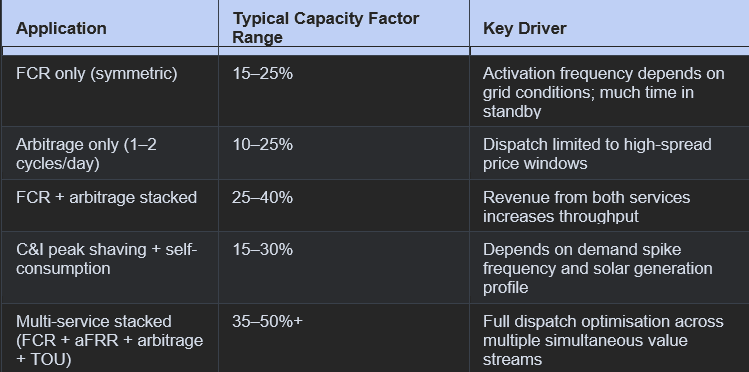
The commercial implication is direct: capacity factor is the leverage point where the EMS converts installed hardware into financial returns. A BESS with 100 MWh of capacity and a 20% capacity factor delivers 20 MWh of throughput per cycle period. The same hardware under an EMS that stacks services and dispatches opportunistically across multiple markets might reach 40% — doubling the throughput and the associated revenue from the same capital investment.
Battery degradation adds a constraint that makes EMS intelligence more valuable, not less. Higher cycling throughput means faster degradation — but only if the cycling is unmanaged. An EMS that optimises dispatch while respecting state-of-health boundaries, depth-of-discharge limits, and temperature constraints can maintain a high capacity factor without accelerating end-of-life. The EMS's warranty tracking and SoH forecasting capabilities directly support this: they make the trade-off between throughput and battery longevity visible, measurable, and manageable.
How These Three Services Connect
Frequency regulation, black start, and capacity factor are not independent metrics — they are interdependent, and the EMS is the layer that manages their interaction.
Frequency regulation contributes directly to capacity factor by keeping the battery actively dispatched across market hours. A BESS committed to FCR is cycling throughout the day in response to frequency deviations, accumulating throughput that a standby-only asset does not. Adding aFRR or arbitrage on top of FCR increases the cycling further, driving capacity factor upward — but only if the EMS can manage the state-of-charge constraints that each service imposes without allowing one to starve the other of the energy reserve it needs.
Black start capability imposes a reserve requirement that works against capacity factor if not managed intelligently. A BESS committed to black start readiness must maintain a minimum state of charge at all times — energy that cannot be used for arbitrage or frequency regulation without risking the black start obligation. The EMS must balance this reserve against the revenue opportunity cost of keeping energy idle, ensuring that the black start commitment is honoured while the remaining capacity earns from active services.
The practical outcome is that a BESS delivering all three capabilities simultaneously — frequency regulation revenue, black start resilience, and a high capacity factor from intelligent dispatch — is a fundamentally different asset proposition from one delivering any single service. The difference is not in the battery hardware. It is in the EMS's ability to orchestrate multiple obligations, enforce the constraints each service requires, and maximise throughput within the boundaries those constraints define.
Frequently Asked Questions
What is frequency regulation in battery storage?
Frequency regulation is the use of battery charge and discharge to stabilise grid frequency by injecting power when frequency drops (demand exceeds supply) and absorbing power when frequency rises (supply exceeds demand). It is the fastest-response grid service a BESS provides, with FCR requiring full contracted power within 30 seconds of a triggering event. Revenue is structured as a capacity payment (per MW per week) plus energy payments on actual activation.
What does black start mean?
Black start is the ability to restart a power grid from a complete shutdown without any external electrical supply. It requires a resource that can establish a voltage and frequency reference independently — which is why it depends on grid-forming inverter capability. A BESS with grid-forming PCS units and an EMS capable of sequencing the energization process can provide black start at utility scale, replacing the traditional reliance on hydro or diesel-start gas plants.
What is a good capacity factor for a BESS?
Capacity factor for BESS depends heavily on application and dispatch strategy. Single-service deployments (FCR only, or peak shaving only) typically achieve 10–25%. Multi-service stacked deployments, where the EMS dispatches across frequency regulation, arbitrage, and self-consumption simultaneously, can reach 35–50% or above. Higher capacity factor directly correlates with higher revenue per unit of installed capacity, making it a key metric for asset performance evaluation.
How does the EMS affect capacity factor?
The EMS determines capacity factor by controlling when and how the battery cycles. An EMS that can stack multiple services — dispatching for frequency regulation during market hours, executing arbitrage during price spreads, and managing self-consumption around solar generation — keeps the battery active more of the time, increasing throughput and revenue. An EMS limited to single-service dispatch or requiring manual mode changes will produce a lower capacity factor from identical hardware.
Can a BESS provide frequency regulation and black start at the same time?
Yes, subject to state-of-charge constraints. The EMS must reserve sufficient energy to honour the black start obligation while using remaining capacity for frequency regulation and other services. The Base Power concept allows a defined portion of the system's capacity to be ring-fenced for one service while the remainder earns from others. Managing this allocation in real time is an EMS function, not a manual scheduling task.
Does higher cycling reduce battery life?
Higher throughput does contribute to degradation, but the relationship is not linear and is heavily influenced by how the cycling is managed. Depth of discharge, charge rate, temperature, and state-of-charge range all affect degradation more than cycle count alone. An EMS with SoH forecasting and warranty tracking can optimise dispatch to maintain a high capacity factor while respecting the degradation parameters that protect battery longevity.
How PowerKonnekt Approaches This
The PowerKonnekt EMS is built to deliver all three capabilities from a single control platform. Frequency regulation runs natively — with 3ms frequency sampling, a 20ms control loop, and P-f droop control configurable per TSO market parameters — while black start sequencing coordinates multi-unit grid-forming PCS fleets through the same EMS instance that manages daily frequency and arbitrage dispatch.
Deployed black-start-capable projects under PowerKonnekt EMS include two 100 MW utility-scale assets: the Göktepe BESS (100 MW / 132 MWh) in Yalova, Türkiye, providing black start, FCR, and renewable energy integration; and the Büyükkışla ESS (100 MW / 121.28 MWh) in Ankara, delivering black start, FCR, PPC, and trading platform integration. Both projects operate under the full PowerKonnekt control stack, with the EMS managing the interaction between frequency regulation commitments, black start reserves, and revenue-maximising dispatch in real time.
Capacity factor optimisation is a direct outcome of the EMS's multi-service dispatch architecture. PowerKonnekt's standard function set includes monitoring, load following, peak limiting, scheduled charging, reactive power support, voltage regulation, SoH forecasting, and warranty tracking. The advanced market modules add FCR, aFRR, energy market integration, and automated energy trading. Running these simultaneously from a single EMS — with the control stack managing state-of-charge constraints, degradation boundaries, and service-priority logic at the 20ms loop level — is what drives capacity factor from single-service levels into the multi-service ranges that materially change the financial case for the asset.
PowerKonnekt EMS is brand-agnostic across PCS and BMS manufacturers, validated across hardware from CATL, Jinko, Huawei, LG, Narada, Rolls-Royce (battery side) and Power Electronics, Sinexcel, Sungrow, NR Electric, Sineng, EPC Power (PCS side). For developers and asset operators evaluating grid service capability, PCS selection for grid-forming or frequency-regulation duty should be made on hardware merit, not EMS compatibility.