.webp&w=3840&q=75)
Protecting Battery State of Health
Two identical batteries, installed the same day, can be years apart in health a decade later. The difference is not the hardware. It is how they were run.
The state of health of a battery is the capacity it can still hold, expressed as a percentage of the capacity it held when new. A cell that started at 280 ampere-hours and now holds 196 is at 70% SoH. The arithmetic is trivial— SoH equals current maximum capacity divided by original nameplate capacity, times one hundred —but the number it produces governs almost everything that matters about a storage asset: how much energy it can deliver, how long it will keep delivering it, when it must be replaced, and whether it earns or loses money across its life.
What most explanations of SoH leave out is the part that is actually within an operator's control. SoH is presented as something the battery management system measures, as though health were a fixed property that unfolds on its own and simply needs monitoring. It is not. How a battery is operated — the temperatures it runs at, the depth to which it is cycled, the rate at which it is charged, the state of charge at which it sits idle — is one of the largest determinants of how fast it loses health. Unoptimised cycling alone can shorten battery life by as much as 20%. This guide covers what SoH measures, why it is a financial metric before it is a technical one, the operating factors that decide how fast it falls, why it is genuinely hard to know accurately, and how intelligent operation protects it.
What State of Health Actually Measures
SoH is usually described through capacity, but it has two physical dimensions, and both matter. The first iscapacity fade: the gradual loss of how much charge the cells can hold. The second isinternal resistance growth: as cells age, their internal resistance rises, which means less current is delivered at a given voltage and more energy is lost as heat. A battery can look acceptable on capacity while its rising resistance quietly erodes efficiency and adds thermal stress. A complete picture of health tracks both. The mechanisms that drive these two are covered in PowerKonnekt's guide to battery degradation and lifetime.
SoH is also inseparable from state of charge. State of charge is the real-time fuel gauge, the energy in the battery right now; state of health is the size of the tank over the years. As health falls, the usable range that a given state-of-charge reading corresponds to shrinks, and state-of-charge estimation itself becomes harder for the control system to get right. The two metrics move together, and neither is fully meaningful without the other.
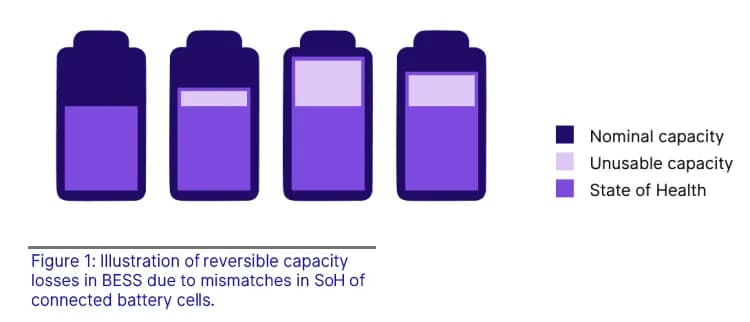
The Health Bands That Decide When to Act
SoH is most useful read as a series of thresholds rather than a single number, because each band carries a different operational meaning and a different decision.
Above 90%, cells retain essentially as-new performance and demand no special attention. Between 80% and 90%, some degradation is present but normal operation is unaffected. Between 70% and 80%, performance degradation becomes noticeable, and operators in demanding applications such as energy trading or frequency regulation begin planning cell replacement. At 70%, the industry conventionally marks end of life for demanding, revenue-critical use cases, and many operators replace cells at this point. Below 70% the battery is not necessarily finished: cells can often run safely down to around 50% SoH in less demanding roles such as renewable time-shifting, which is precisely why retired cells find a second working life. This is the logic behind repurposing covered in PowerKonnekt's guide to
battery recycling and second-life BESS.
The practical point buried in these bands is that end of life is not a hardware fact but an application decision. The same cell at 72% SoH is retired from a trading asset and perfectly serviceable in a time-shifting one. Knowing precisely where a battery sits on this ladder, and how fast it is descending, is what lets an operator make that call deliberately rather than discovering it during a failure.
Why SoH Is a Profit Metric Before It Is a Technical One
It is tempting to treat state of health as an engineering readout. For an asset owner it is closer to a financial statement, because nearly every economic outcome of a storage project runs through it.
The value of a storage asset is largely a function of how long it lasts, and how long it lasts is what SoH tracks. A battery that reaches its replacement threshold in year eight instead of year twelve has had a third of its expected value erased, and the cause is usually operational rather than defective hardware. Accurate SoH knowledge also determines whether an operator captures the full capacity they paid for: a system whose true health is better than its conservative estimate is leaving revenue unclaimed, while one whose health is worse than assumed is exposed to sudden shortfalls and warranty disputes.
There is a safety and Opex dimension as well. When SoH falls too far and ageing becomes severe, the risk of thermal events rises, and a fire forces the replacement of far more cells and containers than proactive management ever would. Tracking health accurately lets operators replace only the cells that need it, avoid catastrophic events, and preserve the availability the asset's contracts depend on. Health also feeds directly into financeability: an asset with a documented, well-managed SoH history and a credible degradation trajectory is more bankable than an identical system without that record.
The Operating Factors That Decide How Fast SoH Falls
Cells age from the day they are made, through calendar ageing, whatever they do. But how they are used adds cyclic ageing on top, and the operating regime is where the largest avoidable losses occur. Four factors dominate, and every one of them is a lever a control system can move.
Temperature.Heat is the single most aggressive accelerator of ageing. Elevated temperatures speed the chemical reactions that consume a cell's usable lithium and grow its internal resistance, and the effect compounds: a battery run consistently warm ages faster in every other respect too. Keeping cells within their optimal thermal window is the highest-leverage protection available, which is why thermal management is central to preserving health rather than a background utility.
Depth of discharge.Repeatedly cycling a battery across most of its capacity ages it faster than shallower cycling. Deep discharges impose more structural stress on the electrodes per cycle, so a system regularly run to the extremes of its range loses health faster than one operated within a moderate window. The relationship between cycling depth and cycle life is covered in the guide to state of charge, depth of discharge, and cycle life.
Charge and discharge rate.High C-rates — moving large amounts of energy in and out quickly — generate heat and mechanical stress inside the cell, both of which accelerate ageing. Fast, aggressive operation has a real health cost, which is why the value of a high-power dispatch must be weighed against the degradation it causes rather than taken for granted.
Idle state of charge.A battery is not resting harmlessly when it sits idle. Held at a high state of charge, particularly in warm conditions, it undergoes accelerated calendar ageing even while doing no work. Where operations allow, keeping idle state of charge in a moderate band rather than fully charged materially slows this hidden loss.
The unifying insight is that these are not independent hazards to be avoided one at a time. They interact, and they are all governed by the same operational decisions. A single dispatch choice sets the C-rate, the depth, the resulting temperature, and the state of charge the battery lands at afterwards. Protecting health is therefore not a matter of policing four separate factors but of making each operating decision with their combined effect in view.
Why Knowing Your True SoH Is Genuinely Hard
Protecting health assumes you can see it accurately. In practice, knowing a large battery's true SoH is one of the harder problems in storage operation, and the gap between measured and true health is where costly mistakes hide.
The conventional way to measure SoH precisely is a calibration cycle: charging and discharging the battery through a controlled profile across as wide a state-of-charge range as possible. The problem is that this typically requires taking the system offline for hours, which for a grid-critical asset means forfeiting the ancillary-service revenue and grid support it exists to provide. There is a direct tension between measuring health accurately and keeping the asset earning, and it is felt most acutely on exactly the high-value assets where health matters most. This is one reason continuous, non-intrusive health estimation — the kind a capable cloud EMS and asset-management platform provides — matters so much.
Estimation is also intrinsically difficult. Many battery management systems use linear, cycle-count-based estimates that do not account for depth of discharge, thermal history, or the other stresses that cause accelerated ageing, so real degradation can be masked and the reported SoH can drift away from the truth. Pack-level physics compounds the problem: a large system contains thousands of cells in series and parallel, manufactured to slightly different tolerances and ageing non-uniformly, and a single badly degraded cell can constrain and misrepresent the health of the whole string.
Chemistry adds a final layer. The lithium iron phosphate cells that now dominate stationary storage have a flat open-circuit-voltage curve and exhibit hysteresis, where the charge and discharge voltage curves do not match, which makes state-of-charge and state-of-health estimation markedly harder than for other chemistries. Overcoming this requires more sophisticated estimation than simple voltage lookup — the same LFP estimation challenge discussed in the guide to state of charge and cycle life. The consequence is that an operator relying on a naive health readout may be making replacement, dispatch, and financial decisions on a number that is materially wrong.
Protecting SoH Through Intelligent Operation
If operation is what determines how fast health falls, then health is protected the same way it is lost: through the control decisions made every second of the asset's life. This is where the operational layer moves from measuring health to actively preserving it, and it works along four lines that mirror the four ageing factors.
Thermal protection.Because heat is the dominant accelerator of ageing, keeping cells within their optimal thermal window is the most valuable single intervention. Intelligent thermal management coordinates cooling with operation and curtails high-power dispatch when temperatures approach limits, ensuring the asset is not quietly traded for a marginal revenue opportunity that costs more in lost life than it earns.
Cycle and depth discipline.A health-aware control layer does not cycle deeper or more often than the task requires. It delivers the contracted service using the shallowest cycling and the lowest C-rate that will accomplish it, reserving aggressive operation for when its value genuinely exceeds its degradation cost. Over thousands of cycles, that discipline is the difference between reaching end of life early and late.
Idle-state management.Between active tasks, a protective control layer avoids parking the battery at a high state of charge, holding it instead in a band that slows calendar ageing without compromising readiness for its next obligation. This addresses a loss that accrues silently and is invisible to operators who think of the battery as inert when idle.
Degradation-aware dispatch.The decisive capability is treating degradation as a real cost in every dispatch decision. A control layer that knows the health cost of an action can decline the opportunities where that cost exceeds the value captured, and take the ones where it does not — protecting the asset's long-term value while still earning from it. This is the same lifecycle-aware optimisation that underpins accurate energy storage efficiency.
None of this requires sacrificing the asset's earnings. It requires making the trade-off between immediate revenue and long-term health consciously, on every decision, instead of ignoring the health side entirely. An asset run this way earns across a longer life, holds more of its capacity, and reaches its replacement threshold years later than an identical system operated without regard to what each cycle costs it.
Frequently Asked Questions
What is a good state of health for a battery?
Above 90% SoH, cells retain essentially as-new performance. Between 80% and 90%, minor degradation is present but normal operation is unaffected. Between 70% and 80%, performance degradation becomes noticeable and operators in demanding applications begin planning replacement. 70% is the conventional end-of-life threshold for revenue-critical uses such as trading and frequency regulation, though cells can often run safely to around 50% in less demanding roles like renewable time-shifting.
How is state of health calculated?
SoH is the battery's current maximum capacity divided by its original nameplate capacity, expressed as a percentage. A 280 ampere-hour cell now holding 196 ampere-hours is at 70% SoH. The formula is simple; the difficulty is accurately determining the current maximum capacity, which requires accounting for temperature history, depth of discharge, internal resistance growth, and cell-to-cell variation rather than a simple cycle count.
Can you improve a battery's state of health?
SoH loss is permanent — it cannot be reversed. But the rate at which SoH falls can be slowed substantially through operation. Because unoptimised cycling can shorten battery life by as much as 20%, operating within safe thermal limits, avoiding unnecessary deep cycles and high C-rates, and not parking the battery at high state of charge all preserve remaining health and extend usable life. Protection is about slowing future loss, not recovering past loss.
What most affects battery state of health?
Temperature is the single most aggressive accelerator of ageing, followed by depth of discharge, charge and discharge rate, and idle state of charge. Calendar ageing occurs regardless of use, but these operational factors add cyclic ageing on top and account for the largest avoidable losses. All four are governed by operating decisions, which is why how a battery is used matters as much as the hardware itself.
Why is state of health hard to measure accurately?
Precise measurement traditionally requires a calibration cycle that takes the system offline for hours, forfeiting revenue. Many battery management systems instead use linear, cycle-based estimates that miss depth of discharge and thermal effects, so degradation can be masked. Pack-level cell variation and the flat voltage curve and hysteresis of LFP chemistry make estimation harder still, so measured SoH can drift meaningfully from true SoH without advanced estimation methods.
Does state of health affect a battery's value?
Directly and substantially. A storage asset's value is largely a function of how long it lasts, which SoH tracks, so a battery that reaches its replacement threshold years early loses a large share of its expected value. Accurate SoH knowledge also determines whether an operator captures the full capacity they paid for, avoids costly thermal events, and can demonstrate a credible degradation trajectory to lenders, all of which make health a financial metric as much as a technical one.
PowerKonnekt's SoH Tactics
PowerKonnekt treats state of health as something to protect through operation, not merely to display. Because heat is the dominant driver of ageing, the platform's control keeps operation within safe thermal bounds, coordinating with thermal management and curtailing high-power dispatch when temperatures drift toward limits — the highest-leverage protection a control layer can provide. Continuous battery monitoring underpins this, with the battery management system polled every10 millisecondsfor voltage, current, temperature, and state of charge across the system, giving the platform the granular, real-time visibility that health-aware decisions require.
The platform'sSoH forecastingtracks degradation continuously across the operating life rather than relying on a linear cycle count, producing a health trajectory as a measurement rather than an estimate — and doing so without taking the asset offline for calibration, so the system keeps earning while its health is tracked.Warranty trackingensures the battery operates within the manufacturer's defined limits on cycles, depth of discharge, and temperature, preserving both capacity and the audit-ready record that protects warranty claims and asset value.
Above all, the optimisation engine operates with degradation as a real cost in every dispatch decision, declining opportunities where the health cost would exceed the value captured and taking those where it would not — the discipline that turns as much as 20% of avoidable life loss back into asset value. Because the platform is hardware-agnostic across battery and power-conversion manufacturers, it applies this protection to whatever cells a project deploys.