Grid Forming BESS
As the grid loses the rotating inertia that kept it stable, grid-forming battery storage is becoming the engineered replacement and a connection requirement as well.
For more than a century, the stability of the electrical grid rested on physics that required no active management. The synchronous generators in coal, gas, hydro, and nuclear plants — massive rotating machines spinning in lockstep with grid frequency — stored kinetic energy in their rotating mass. When a sudden imbalance hit the system, that stored energy resisted the change automatically, slowing the rate at which frequency could move and buying control systems precious seconds to respond. This property, inertia, was a free byproduct of how electricity was generated.
That foundation is eroding. As synchronous generators retire and are replaced by inverter-based resources — solar, wind, and battery storage connected through power electronics rather than spinning mass — the grid is losing the physical inertia that kept it stable. The replacement does not come automatically. It has to be engineered. Grid-forming technology is the engineering answer, and battery energy storage systems are emerging as the most capable platform to deliver it.
This guide explains what grid forming is, how it differs from the grid-following approach that has dominated inverter design, why it has moved from a niche capability to a grid-code priority across European markets, and where the energy management system fits in delivering it.
What Is Grid Forming?
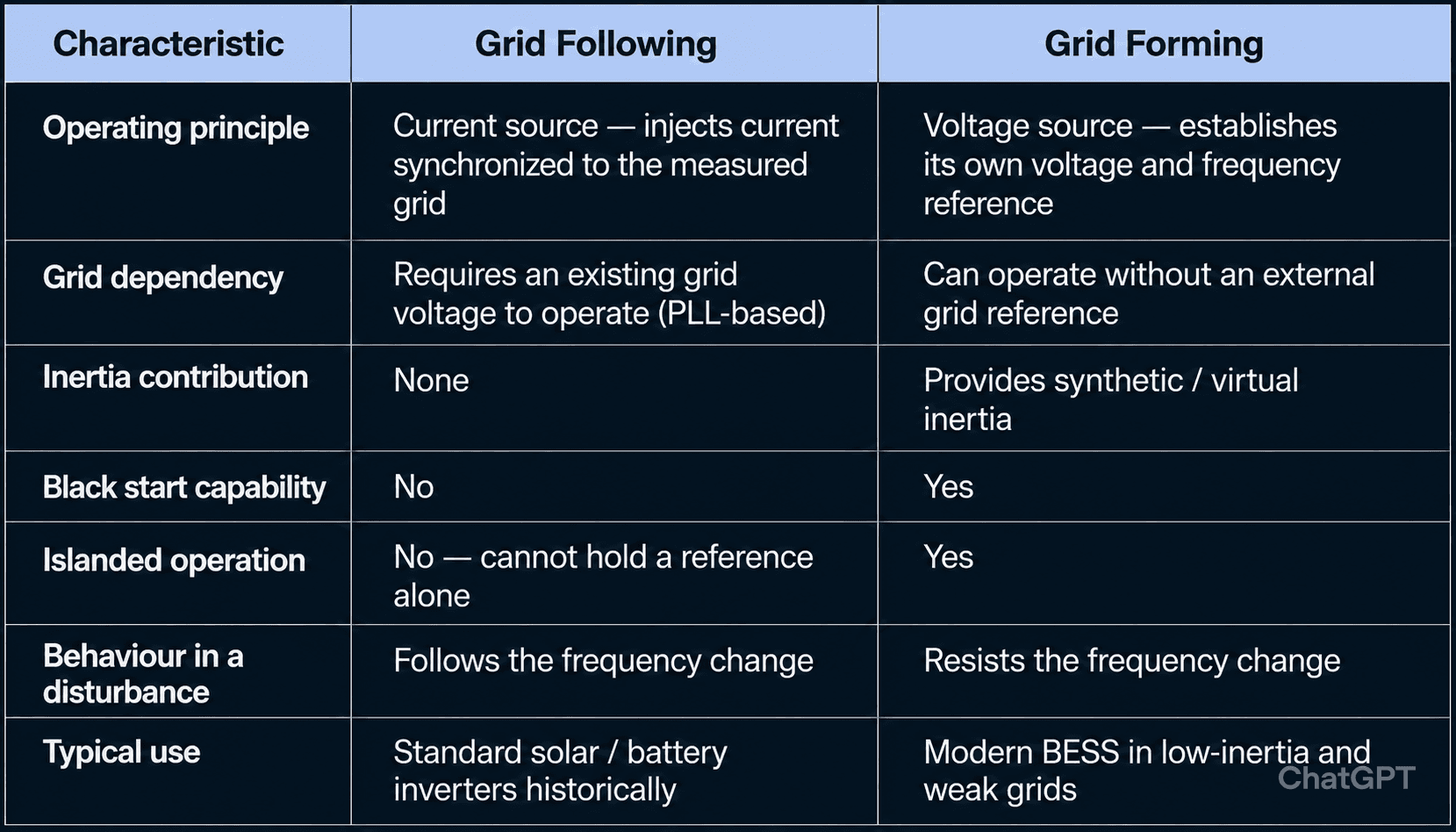
Grid forming describes a mode of inverter operation in which the inverter establishes and maintains its own voltage and frequency reference, behaving as a voltage source that the rest of the grid can synchronize to. A grid-forming inverter does not need a pre-existing grid to operate — it can create the reference itself.
This is a fundamental departure from the conventional approach, known as grid following. A grid-following inverter operates as a current source: it measures the existing grid voltage and frequency using a phase-locked loop (PLL), then injects current synchronized to that measured reference. A grid-following inverter cannot operate without an external voltage reference to lock onto. Remove the grid, and it shuts down.
The distinction is more than technical taxonomy. A grid-following inverter is a passive participant — it contributes power but depends entirely on other resources to define the grid's voltage and frequency. A grid-forming inverter is an active participant — it helps define the grid's voltage and frequency, contributing to system stability in the same way a synchronous generator does. In a grid increasingly dominated by inverter-based resources, this difference determines whether the system remains stable.
Why Grid Forming Matters Now: The Inertia Decline
The reason grid forming has become urgent is the decline of system inertia. Inertia is the resistance of the power system to changes in frequency. In a traditional grid, it comes from the kinetic energy stored in the rotating masses of synchronous generators. When a large generator trips offline or a major load connects suddenly, the immediate energy imbalance is absorbed by the rotating mass of every synchronous machine on the system, which releases or absorbs kinetic energy to slow the frequency change.
The metric that captures this is the Rate of Change of Frequency (RoCoF) — how quickly frequency moves in the first moments after a disturbance. High inertia means a low RoCoF: frequency drifts slowly, and control systems have time to respond. Low inertia means a high RoCoF: frequency moves fast, and the window for response shrinks. If RoCoF exceeds the thresholds at which protection relays trip generation, a single disturbance can cascade into widespread disconnection.
As inverter-based resources replace synchronous generators, system inertia falls. Solar panels and wind turbines connected through grid-following inverters contribute no inertia — they have no rotating mass coupled to grid frequency, and their control systems are designed to follow, not resist, frequency changes. A grid running at high renewable penetration during a sunny, windy, low-demand period may have very few synchronous machines online, leaving it vulnerable to fast frequency excursions that the remaining inertia cannot contain.
This is not a theoretical concern. Grid operators in regions with high renewable penetration have already encountered low-inertia conditions that constrain how much renewable generation they can accept at a given moment. The solution is to engineer inertia and fast frequency response back into the system — and grid-forming battery storage is the most flexible, fast-responding, and cost-effective way to do it.
Grid Forming vs Grid Following: A Technical Comparison
The two inverter control philosophies differ at every level — from how they treat the grid to what they can do when the grid is absent. The table below summarises the distinctions that matter when specifying a BESS.
What Grid-Forming BESS Actually Delivers
Grid-forming capability in a battery energy storage system enables several distinct grid-support functions, each addressing a specific stability challenge in modern power systems.
• Synthetic inertia and fast frequency response. A grid-forming BESS responds to frequency disturbances within milliseconds — faster than any synchronous generator — by injecting or absorbing active power in proportion to the rate and magnitude of the frequency change. This emulates the inertial response of a spinning machine, slowing RoCoF and containing frequency excursions in the critical first moments after a disturbance.
• Black start. Because a grid-forming BESS can establish a voltage reference without an existing grid, it can energize a dead network from a complete shutdown — the function known as black start. Following a major blackout, grid-forming storage re-establishes a stable voltage and frequency reference, allowing other generation to synchronize and the system to be progressively restored. This capability was historically provided by specific hydro and gas plants; grid-forming BESS now offers a faster-responding alternative.
• Islanded and microgrid operation. A grid-forming BESS can maintain a stable local grid when disconnected from the main network — supporting industrial sites, remote communities, or critical facilities that must keep operating during a grid outage. The grid-forming inverter holds the voltage and frequency reference for the islanded section, and other local resources synchronize to it.
• System strength and weak-grid support. In areas of the grid far from synchronous generation — often where large renewable plants connect — system strength is low, and grid-following inverters can become unstable. Grid-forming inverters provide the voltage stiffness that weak grid connections require, enabling renewable integration in locations that could not otherwise support it.
The EMS Role in Grid-Forming BESS
A crucial point of clarity: grid-forming behaviour is primarily a function of the power conversion system and its control firmware, operating at the microsecond-to-millisecond timescale of inverter switching. The PCS is what physically establishes the voltage reference and delivers the inertial response. The energy management system does not replace this function — but it makes grid-forming operation viable at the system level, and this distinction matters when evaluating a BESS for grid-forming duty.
The EMS delivers four functions essential to a grid-forming deployment:
• State-of-charge headroom management. Providing synthetic inertia and fast frequency response requires the battery to have energy available to inject and capacity available to absorb. A grid-forming BESS committed to inertial response must maintain a state of charge within a band that guarantees bidirectional response at all times. The EMS enforces this constraint against all other dispatch activities, ensuring the grid-forming commitment is never compromised by arbitrage or other revenue operations.
• Multi-unit coordination. Utility-scale BESS installations comprise many PCS units operating in parallel. The EMS coordinates grid-forming setpoints, droop parameters, and mode states across the full fleet of converters, ensuring they act as a coherent voltage source rather than competing references.
• Mode management and transitions. Some deployments operate in grid-following mode under normal conditions and switch to grid-forming when grid conditions require it — during islanding events or low-inertia periods. The EMS manages these transitions cleanly, coordinating the change across all units without destabilizing the connection.
• Black start sequencing. Black start is a choreographed process: energizing the local network, synchronizing additional resources, and progressively restoring load. The EMS orchestrates this sequence, coordinating the grid-forming PCS units, managing the energization steps, and integrating with the grid operator's restoration procedures.
Technical Note: Why the EMS–PCS Division Matters When Specifying a Grid-Forming BESS
Grid-forming capability is often discussed as though it were a single feature an EMS either has or does not. In practice, the inverter firmware determines whether grid-forming control is physically possible, while the EMS determines whether it can be sustained as an operational commitment alongside the battery's other duties.
A BESS can have grid-forming-capable inverters but fail to deliver reliable grid-forming service because the EMS cannot guarantee the state-of-charge headroom the commitment requires. When evaluating a BESS for grid-forming duty, both layers must be assessed: the PCS for grid-forming control capability, and the EMS for its ability to manage the reserve, coordinate the fleet, and sustain the commitment under real operating conditions.
Grid Codes and Market Signals: Where Requirements Are Heading
Grid-forming capability is moving from an optional premium feature toward a connection requirement, and the direction of travel across European markets is consistent.
Great Britain has been an early mover, with the system operator running dedicated procurement for stability services that explicitly value grid-forming capability, and with grid-forming requirements being written into connection conditions for new storage. The broader European framework, coordinated through ENTSO-E, is developing grid-forming specifications as inverter-based resource penetration rises across interconnected systems. National grid operators are increasingly specifying grid-forming capability — or the ability to provide synthetic inertia and fast frequency response — in the technical requirements for new BESS connections, particularly for utility-scale assets connecting to transmission networks.
The commercial implication for developers is twofold. First, grid-forming capability increasingly determines whether a project can connect at all in certain locations and at certain scales — it is becoming a gating requirement, not a value-add. Second, the markets that reward grid-forming services — stability, inertia, and fast frequency response products — are growing, creating new revenue streams for assets that can deliver them. A BESS specified for grid-forming capability today is positioned for both the regulatory requirements and the market opportunities taking shape across European grids.
Frequently Asked Questions
What is the difference between grid-forming and grid-following inverters?
A grid-following inverter operates as a current source — it measures the existing grid voltage and frequency with a phase-locked loop and injects current synchronized to that reference, which means it cannot operate without an external grid. A grid-forming inverter operates as a voltage source — it establishes and maintains its own voltage and frequency reference, can run without an existing grid, and actively stabilises frequency rather than passively following it.
Does grid forming require a special type of battery?
No. Grid-forming capability is determined by the power conversion system (the inverter) and its control firmware, not by the battery chemistry or cells. Any battery type compatible with a grid-forming-capable PCS can support grid-forming operation. What matters is that the inverter firmware supports grid-forming control and that the EMS can manage the state-of-charge headroom the commitment requires.
Can a grid-forming BESS provide black start?
Yes. Black start — energizing a dead network from a complete shutdown — is one of the defining capabilities of grid-forming technology, because it requires establishing a voltage reference without any existing grid to synchronize to. A grid-forming BESS can re-establish a stable voltage and frequency reference after a blackout, allowing other generation to synchronize and the system to be restored progressively. Delivering black start at scale also requires an EMS capable of coordinating multiple converters and sequencing the energization process.
Is grid forming the same as synthetic inertia?
Not exactly. Synthetic inertia (also called virtual inertia) is one of the services a grid-forming inverter can provide — emulating the inertial response of a spinning machine by injecting or absorbing power in response to frequency changes. Grid forming is the broader operating mode that makes synthetic inertia, black start, islanded operation, and weak-grid support possible. Synthetic inertia is a function; grid forming is the capability that enables it.
Why is grid forming becoming a grid code requirement?
As synchronous generators retire and inverter-based resources grow, system inertia declines and grids become more vulnerable to fast frequency excursions. Grid operators are responding by requiring new connections — particularly utility-scale storage on transmission networks — to provide grid-forming capability or equivalent fast frequency and inertial response. This ensures that as the generation mix shifts, the stability services the grid depends on are maintained rather than lost.
Can an existing grid-following BESS be upgraded to grid forming?
It depends on the inverter hardware. Some modern PCS units support grid-forming operation through a firmware configuration change, while others require hardware capable of voltage-source control that grid-following-only units may lack. Upgrading also requires an EMS that can manage the state-of-charge reserve and multi-unit coordination grid-forming operation demands. Any upgrade assessment should evaluate both the PCS capability and the EMS's ability to sustain the grid-forming commitment.
How PowerKonnekt Approaches This
Grid-forming deployment requires an EMS that can sustain the operational commitment grid-forming service demands — and PowerKonnekt has delivered exactly this at utility scale. The PowerKonnekt EMS coordinates grid-forming setpoints and droop parameters across multi-unit PCS fleets, enforces the state-of-charge headroom that bidirectional inertial response requires, and orchestrates black start sequencing in coordination with grid operator restoration procedures.
PowerKonnekt's black start deployments include two of the largest BESS projects in the region: the 100 MW / 132 MWh Göktepe BESS in Yalova, Türkiye, and the 100 MW / 121.28 MWh Büyükkışla ESS in Ankara — both providing black start and FCR functions under PowerKonnekt EMS coordination. Delivering black start at this scale requires precisely the EMS capabilities grid-forming operation depends on: multi-unit voltage-source coordination, reserve management, and choreographed energization sequencing.
The PowerKonnekt EMS is brand-agnostic across PCS manufacturers, which matters for grid-forming deployment because grid-forming control is implemented in the inverter firmware. PowerKonnekt coordinates grid-forming-capable converters from multiple manufacturers — including Power Electronics, Sinexcel, and others — allowing developers to select inverters on grid-forming capability and cost rather than on EMS compatibility. The protocol stack (Modbus TCP, IEC 61850, IEC 104) supports the converter-level and TSO-level communication that coordinated grid-forming and black start operation requires.
For developers evaluating grid-forming requirements for a specific connection — including PCS selection, EMS coordination, and black start capability — explore the PowerKonnekt utility-scale EMS solutions or contact the technical team at powerkonnekt.com/contact.