
Cloud EMS Asset Management
We present ideas about why the operators managing the most productive BESS portfolios run both an edge controller in the field and a cloud EMS on every screen and why a dashboard alone is not enough.
A single BESS installation managed from a local control room by a dedicated operator is one kind of problem. A portfolio of twelve sites across four countries, with different PCS manufacturers, different battery suppliers, different grid codes, different trading schedules, and a total of 400 MW under management — that is a structurally different problem. The physics at each site are the same. The operational challenge is not.
As the BESS industry scales from individual projects to managed fleets, the architecture of the energy management system must scale with it. An EMS that runs only on a local field computer and requires on-site access for every configuration change, schedule update, or alarm investigation does not support fleet-scale operations. An EMS that runs only in the cloud, with no edge-level field controller, cannot deliver the millisecond response times that frequency regulation and real-time dispatch require.
The answer is both. A cloud EMS layer that provides centralised visibility, remote command execution, alarm management, and portfolio-level analytics — operating above an edge controller at each site that handles the real-time physics of battery dispatch at the speed the grid demands. This guide covers what a cloud EMS delivers, how the edge-cloud architecture works, what fleet-level management changes about the operational model, and what security and compliance requirements apply.
What Cloud EMS Actually Means
The term “cloud EMS” has been applied to products that range from a monitoring dashboard with historical charts to a full remote control platform capable of executing dispatch commands, modifying operating schedules, and managing market participation across multiple sites from a single interface. The difference between these is the difference between watching a system and operating it.
A monitoring-only cloud platform displays data. It shows state of charge, power output, temperature, and alarm history. It can generate reports and send email notifications. What it cannot do is change the system's behaviour — modify a dispatch schedule, adjust a frequency regulation setpoint, initiate a charge or discharge cycle, or override a power level in response to a market signal. For that, someone needs access to the field-level controller, either physically or through a remote connection to the edge device.
A cloud EMS is a full operational layer. It receives real-time data from the edge controller at each site, presents it through a unified interface, and provides the ability to issue commands back to the field. Schedule changes made in the cloud are transmitted to the edge controller and executed locally at the 20-millisecond control loop level. Alarm acknowledgement, mode changes, power setpoint adjustments, and market schedule uploads all happen through the cloud interface — with the edge controller handling the real-time execution that requires sub-second response.
This distinction matters because it determines whether a fleet operator can manage their portfolio from a central operations centre or whether every operational change requires dispatching personnel to a site.
Edge and Cloud: Why You Need Both
The edge-cloud architecture is not a redundancy design — it is a division of labour based on what each layer does best.
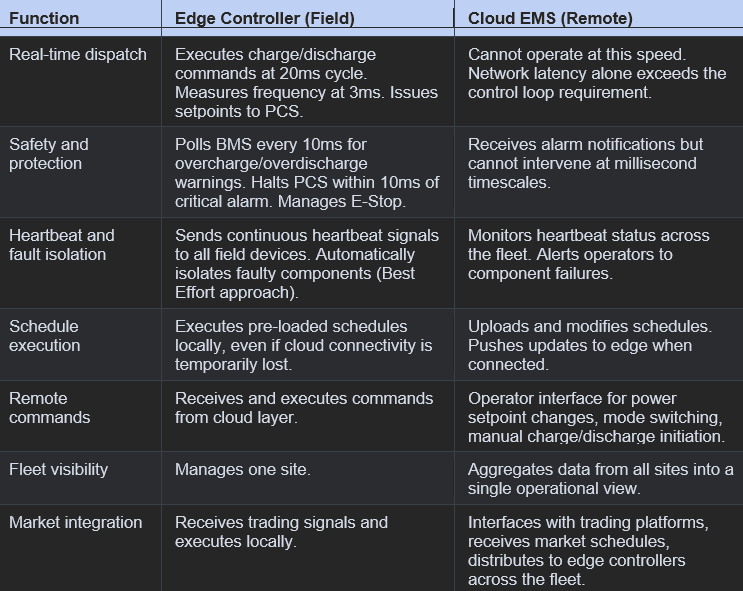
The communication between edge and cloud uses MQTT — a lightweight messaging protocol designed for intermittent, bandwidth-constrained connections. MQTT ensures that data flows continuously from field to cloud during normal operation, and that the edge controller continues operating autonomously if the cloud connection drops. When connectivity restores, the edge transmits buffered data and the cloud resynchronises. No data is lost, and no dispatch function is interrupted.
Technical Note: Why Latency Rules Out Cloud-Only EMS for Grid Services
FCR requires full contracted power within 30 seconds of a frequency deviation exceeding the deadband. The EMS control loop that delivers this runs at 20 milliseconds. Round-trip network latency between a cloud server and a field site — even on a well-provisioned connection — is typically 20 to 100 milliseconds, before accounting for jitter, packet loss, and connection drops.
A cloud-only EMS attempting to control PCS dispatch remotely would consume its entire control budget on network transit alone. The edge controller eliminates this constraint by running the control loop locally. The cloud layer manages everything that operates on a timescale of seconds to hours: schedules, market signals, fleet analytics, and operator commands.
What the Cloud EMS Dashboard Delivers
For a fleet operator, the cloud EMS dashboard is the primary operational interface. It consolidates the status of every site, every battery rack, every PCS unit, and every active market obligation into a single view. The specific capabilities that differentiate a cloud EMS from a monitoring platform are:
• Live fleet overview. Every site’s status (Ready, Active, Fault, Standby) visible on a single screen, with drill-down to individual battery racks and PCS units. Real-time SOC, power output, temperature, and active operating mode displayed per site and per component.
• Remote command execution. Operators can initiate charge or discharge cycles, modify power setpoints, switch operating modes (manual, scheduled, frequency regulation, peak limiting), and adjust SOC limits from the cloud interface. Commands are transmitted to the edge controller and executed locally.
• Alarm management and customisation. All alarms from every site are aggregated in the cloud, with filtering, prioritisation, and acknowledgement workflows. Operators can configure custom alarm conditions based on specific thresholds or operational scenarios. Email notifications are triggered automatically for critical conditions, including low SOC alarms.
• Schedule management. Charge/discharge schedules, trading windows, frequency regulation activation periods, and maintenance windows are created and managed centrally, then pushed to the relevant edge controllers. Schedule changes propagate to the field within seconds of operator confirmation.
• Historical analytics and reporting. Energy throughput, revenue attribution per service, availability metrics, degradation tracking, and compliance records across the fleet. Data is retained in the cloud for long-term trend analysis and investor reporting.
• Multi-user access with role-based permissions. Different access levels for operators, asset managers, trading teams, investors, and maintenance personnel. An investor dashboard shows performance and revenue. An operator dashboard shows alarms and control surfaces. A trading view shows market schedules and dispatch compliance.
Fleet Management: What Changes at Portfolio Scale
Managing a single BESS site is an engineering problem. Managing a fleet of storage assets across multiple markets is an operations and commercial problem. The cloud EMS is the tool that makes the transition from project-level to portfolio-level management possible.
Cross-Site Optimisation
A fleet operator with sites in Germany, Turkey, Finland, and Romania operates under different grid codes, different tariff structures, different frequency regulation markets, and different trading platform integrations. The cloud EMS holds the market configuration for each site and ensures that the right dispatch logic runs at the right location — FCR under Fingrid rules in Finland, aFRR under TransnetBW rules in Germany, peak limiting under local tariff structures in Turkey — all visible and manageable from a single operations centre.
Cross-site optimisation also extends to maintenance scheduling. A fleet operator can stagger planned downtime across sites to maintain overall portfolio availability, coordinating battery maintenance windows with market obligation schedules to minimise revenue impact.
Multi-Asset Monitoring
Modern energy portfolios are not battery-only. A single operator may manage BESS installations alongside solar plants, wind farms, and conventional generators. The cloud EMS integrates data from all connected energy resources — solar inverters via PV SCADA, wind turbines via wind SCADA, generators via direct Modbus connection — into the same monitoring and control interface. This unified view is essential for hybrid plant management, where the EMS coordinates battery dispatch with renewable generation output and generator schedules under a single Power Plant Controller function.
Centralised Trading Integration
Energy trading for a multi-site BESS portfolio requires schedule distribution to each site, compliance tracking across market obligations, and post-trade settlement reporting. The cloud EMS receives market schedules from trading platforms — via REST API or Modbus TCP — and distributes them to the relevant edge controllers. Post-dispatch, the cloud aggregates actual delivery data for settlement and compliance verification, closing the loop between the trading team’s decisions and the physical assets’ execution.
Security and Compliance for Cloud-Connected BESS
A cloud EMS that can issue dispatch commands to utility-scale battery systems is, by definition, a critical infrastructure control surface. The security architecture must reflect this.
The EU’s NIS2 Directive (Directive 2022/2555) classifies grid-connected energy storage as critical infrastructure, imposing mandatory cybersecurity risk management, incident reporting, and supply chain compliance requirements on operators. For an EMS platform, this means encrypted communication between edge and cloud, access control with multi-factor authentication, audit logging of all operator actions and command transmissions, and data sovereignty — ensuring that operational data from EU assets is hosted within EU jurisdiction.
IEC 62443 — the international standard for industrial automation and control system cybersecurity — provides the technical framework for securing the OT (operational technology) layer. This standard covers network segmentation between IT and OT systems, secure remote access protocols, device identity and authentication, and vulnerability management for deployed field controllers. Achieving IEC 62443 certification for the EMS platform demonstrates to investors, insurers, and grid operators that the control system meets the cybersecurity requirements that utility-scale BESS deployments demand.
ISO 27001 certification covers the information security management system — the organisational policies, procedures, and controls that govern how data is handled, stored, and accessed across the cloud platform. For fleet operators managing assets across multiple countries, ISO 27001 compliance provides the baseline assurance that the EMS vendor’s security practices meet institutional requirements.
Expert Note: Data Sovereignty in Multi-Country BESS Fleets
A cloud EMS managing assets across Germany, Turkey, Finland, and Romania processes operational data from four different jurisdictions. Under NIS2 and evolving national transposition laws, hosting operational or control data offshore introduces jurisdictional exposure. Cloud EMS platforms serving EU assets should host within the EU, with clear data residency documentation available for lender due diligence, insurance underwriting, and regulatory review.
For fleet operators, IPPs, and developers evaluating cloud EMS capability for multi-site BESS management — including remote command execution, market integration, and cybersecurity compliance — explore PowerKonnekt utility-scale solutions or contact the technical team at powerkonnekt.com/contact.
Frequently Asked Questions
What is the difference between a cloud EMS and a SCADA dashboard?
A SCADA dashboard monitors and displays system data. A cloud EMS monitors, displays, and enables remote control — operators can issue dispatch commands, modify schedules, switch operating modes, and adjust setpoints directly from the cloud interface. The cloud EMS also integrates market schedules, distributes them to field controllers, and aggregates compliance data for settlement. SCADA observes; a cloud EMS acts.
Does a cloud EMS replace the on-site edge controller?
No. The edge controller handles all real-time control functions that require millisecond response — frequency measurement at 3ms, control loop execution at 20ms, BMS polling at 10ms, and safety shutdowns within 10ms of alarm triggers. The cloud EMS operates at a complementary timescale, managing schedules, fleet visibility, remote commands, and market integration. Both layers are required for a complete operational architecture.
What happens if the cloud connection drops?
The edge controller continues operating autonomously using its locally stored schedule and configuration. Safety functions, frequency regulation, and active dispatch continue without interruption. When the cloud connection restores, buffered data is transmitted and the cloud dashboard resynchronises. Pre-programmed schedules resume from the point of interruption. The edge-to-cloud protocol (MQTT) is specifically designed for resilience in intermittent connectivity conditions.
Can a cloud EMS manage sites with different hardware manufacturers?
Yes, if the EMS is brand-agnostic. A cloud EMS built on vendor-neutral protocols manages sites running different PCS and BMS hardware under the same interface. Each edge controller is configured for its local hardware stack, and the cloud layer aggregates data from all sites regardless of the underlying equipment manufacturers. This is a critical requirement for fleet operators who have acquired or developed sites with different hardware selections.
How does a cloud EMS handle cybersecurity for remote commands?
Secure cloud EMS platforms use encrypted communication channels between edge and cloud, multi-factor authentication for operator access, role-based permissions that restrict command authority by user level, and comprehensive audit logging of all actions and command transmissions. Compliance with IEC 62443 (industrial OT cybersecurity), ISO 27001 (information security management), and the NIS2 Directive (EU critical infrastructure) provides the standards framework. Data sovereignty provisions ensure operational data is hosted within the required jurisdiction.
Can the cloud EMS integrate with energy trading platforms?
Yes. Market schedules from trading platforms are received by the cloud EMS via REST API or Modbus TCP, then distributed to the relevant edge controllers for execution. After dispatch, the cloud aggregates actual delivery data for settlement and compliance reporting. This integration supports Day-Ahead, Intraday, and Balancing market participation, as well as automated energy trading through platforms used by the operator’s commercial team.
How PowerKonnekt Approaches This
The PowerKonnekt platform is built as a native edge-plus-cloud architecture. The PowerKonnekt Edge — an industrial-grade field controller designed for continuous operation in harsh environments — runs the 20ms control loop, 3ms frequency sampling, and 10ms BMS polling that real-time grid services require. The PowerKonnekt Cloud EMS provides the fleet management layer: centralised dashboard, remote command execution, alarm management, schedule distribution, market integration, and portfolio-level analytics.
Edge-to-cloud communication runs over MQTT, ensuring continuous data flow during normal operation and autonomous edge operation during connectivity interruptions. Schedule changes made in the cloud propagate to the edge within seconds. All operator actions and command transmissions are audit-logged. Multi-user access with role-based permissions separates operator, asset manager, trading, investor, and maintenance views.
PowerKonnekt Cloud EMS manages assets across nine countries from a single interface. Deployed fleet includes utility-scale installations in Turkey (Göktepe 100 MW, Büyükkışla 100 MW, Ege RES 20 MW), grid-scale projects in Romania and Hungary, C&I deployments in Germany, Greece, and Finland, and multi-site VPP coordination across the KEDEP project spanning Istanbul, Eskişehir, and Denizli. Each site runs different hardware configurations — CATL, Jinko, Huawei, LG batteries; Sungrow, Sinexcel, Power Electronics PCS units — all managed under the same cloud interface because the EMS is brand-agnostic at both the edge and cloud layers.
Multi-asset monitoring extends beyond battery storage. PowerKonnekt integrates solar generation (via PV SCADA), wind generation (via Wind SCADA), conventional generators, and EV charging infrastructure into the same cloud view. For operators managing hybrid portfolios — BESS coupled with renewable generation under a Power Plant Controller — the cloud EMS provides the unified operational interface that asset-specific monitoring tools cannot deliver.
Security is built into the architecture: ISO 27001 certified, NIS2-aligned, with IEC 62443 industrial OT cybersecurity certification in progress. PowerKonnekt is positioned to be the first EU-based EMS provider to achieve IEC 62443 certification — a differentiator for operators whose investors, insurers, and grid operators require demonstrated compliance with critical infrastructure cybersecurity standards.