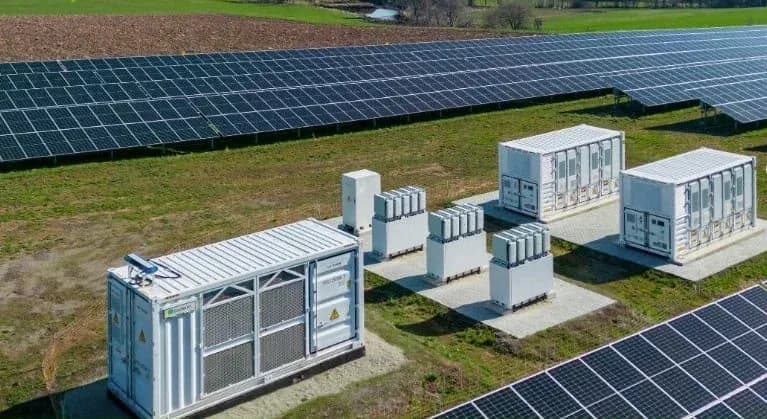
Co-Located Solar Wind Storage: Hybrid BESS
Putting a battery next to a solar or wind farm is the easy part. Whether the combination earns more than the two assets would apart depends entirely on how the shared connection is coupled and controlled.
Co-location,which isplacing renewable generation and battery storage at a single site behind a shared grid connection, has moved from a niche configuration to one of the defining structures of the European storage market. The reasons are economic and increasingly urgent. Standalone renewable generators are watching their revenue erode as their own output depresses prices during the hours they generate, and standalone batteries face a grid connection queue that can stretch for years. Co-location addresses both problems at once, which is why it has become one of the most active areas of storage investment across Europe.
But co-location is not automatically profitable. A poorly coupled, poorly controlled hybrid can under perform the two assets it combines. This guide covers why co-location has become compelling, the coupling architectures that determine what the combination can physically do, the revenue structures that monetise it, and — the part that decides whether the promised economics actually materialise — the control layer that coordinates generation and storage against a shared connection. Co-location is a specific structure within the broader subject of renewable integration; for the wider view, see PowerKonnekt's guide to the complete BESS EMS guide.
Why Co-Location Became Compelling
Three pressures have converged to make co-location one of the most attractive structures in European renewables, and each of them is intensifying.
The Connection Queue
Grid connection has become the binding constraint on renewable and storage deployment across Europe. More than 1,600 GW of renewable and storage capacity is currently waiting in European grid connection queues. In Germany alone, developers have submitted grid connection requests for roughly 161 GW of battery storage — about a hundred times the capacity currently installed. Against that backdrop, a project that can use an existing or already-approved connection rather than joining the queue for a new one has a decisive time-to-market advantage. Adding storage to a site that already holds a connection, or building generation and storage together under one connection application, sidesteps the single biggest bottleneck in the market.
Capture-Price Cannibalization
The second pressure is the self-inflicted price erosion that renewable generators increasingly face. As solar penetration rises, solar output is concentrated in the same midday hours across a whole market, driving prices down precisely when solar generators are trying to sell. The same dynamic affects wind. This capture-price cannibalization is projected to deepen sharply: by 2030, analysts forecast solar capture-price discounts approaching 50% in Iberia and onshore wind discounts exceeding 25% in Germany. A co-located battery directly counters this by storing generation during the cannibalized low-price hours and shifting it to higher-value periods, lifting the effective capture price of the whole asset. The time-shifting mechanism itself is covered in PowerKonnekt's guide to energy arbitrage with battery storage.
Curtailment and Revenue Saturation
The third pressure comes from two directions. Curtailment — renewable output the grid cannot accept and instructs offline — is projected to rise from more than 10 TWh across key European markets in 2024 to roughly 33 TWh by 2030. Every curtailed megawatt-hour is lost revenue. At the same time, standalone battery revenues are forecast to decline by around20% by 2040 as storage markets saturate and the easy arbitrage spreads compress. Co-location answers both: the battery captures generation that would otherwise be curtailed, and the hybrid structure diversifies revenue so the project is less exposed to the saturation of any single market. Germany's Solar Peak Act has added regulatory momentum, with design features that benefit co-located batteries more than standalone systems.
The Coupling Decision: AC, DC, and What Each Makes Possible
Before revenue strategy, before dispatch optimisation, co-location poses a physical question that shapes everything downstream: where does the battery connect relative to the inverter? This is the AC-versus-DC coupling decision, and it determines what the hybrid can and cannot do.
AC-Coupled: Two Assets, One Connection
In an AC-coupled configuration, the battery and the generation each have their own inverter and connect on the alternating-current side, joining before the shared grid connection point. The two assets operate largely independently, sharing the connection but little else. This is the natural choice for adding storage to an existing generation plant, because the existing inverters and grid approval remain untouched. It also lets the battery charge from the grid as well as from local generation, and lets the two assets participate in markets as distinct resources. Its limitation is that an AC-coupled battery cannot capture energy the generation inverter clips on the direct-current side, because by the time power reaches the AC bus, that clipping has already occurred.
DC-Coupled: Shared Inverter, Captured Clipping
In a DC-coupled configuration, the battery shares an inverter with the generation, connecting on the direct-current side behind it. Because solar arrays are commonly oversized relative to their inverter to widen the output shape, the inverter clips the excess at peak generation, and that clipped energy is normally lost as heat. A DC-coupled battery can capture it before it reaches the inverter. Industry data indicates systems with a 1.5-to-1 DC-to-AC ratio can recover around 90% of clipped energy, translating to roughly 5% additional annual yield. DC coupling also makes it physically impossible to export more than the grid connection permits, since the shared inverter is the bottleneck — which network operators sometimes prefer, and which can ease connection approval in some regions.
Neither architecture is universally correct. DC coupling excels for new-build solar-plus-storage where clipping recovery and integrated design matter; AC coupling suits retrofits to existing plants, standalone-then-combined phasing, and cases where the battery must charge from the grid and trade as an independent resource. The right answer depends on site status, interconnection strategy, and revenue model — and in every case, the manufacturer of the inverter, battery, and controller must be compatible, which is where a hardware-agnostic control layer becomes a practical precondition rather than a preference. The sizing interactions this creates are covered in PowerKonnekt's guide to how to size a BESS.
The Revenue Structures: Hybrid PPAs and Tolling
Co-location's economics are realized through contract structures that are themselves evolving quickly, and the control layer has to be able to execute whatever structure the project adopts.
The hybrid power purchase agreement is gaining traction across Europe, with more than700 MW contracted in 2025and Spain leading activity. A hybrid PPA covers a facility combining generation and storage under a single contract, and it can be structured around different charging rules — for instance, a battery charged exclusively by the co-located renewable generation, which carries a cleaner green-energy claim, versus one permitted to charge from the grid, which offers more operational flexibility. Each structure imposes different constraints on how the battery may be dispatched, and the control system must enforce those constraints continuously while still optimizing within them.
Tolling agreements are a second common structure, in which a flexibility trader pays for the right to dispatch the battery in exchange for a fixed fee, transferring market risk from the asset owner to the trader. A single hybrid project may layer these: a medium-term PPA fixing part of the generation revenue, a tolling agreement covering the battery, and merchant exposure on the remainder, with the mix shifting over the project's life. Real European hybrid projects are already combining seven-year PPAs on the solar output with seven-year tolling agreements on the battery, sharing one grid connection that also serves existing wind capacity. A control layer that cannot switch cleanly between contracted and merchant modes, or coordinate obligations across co-located assets, cannot serve these structures.
Why the EMS Determines Whether Co-Location Pays
A co-located hybrid is not two assets that happen to share a fence. It is a single system whose value comes from coordinating generation and storage against a shared, constrained connection in real time. That coordination is the EMS's job, and it is where co-location succeeds or disappoints.
Shared-connection management. The defining constraint of a co-located hybrid is that generation and storage compete for one connection with a fixed export limit. When generation alone would exceed that limit, the battery must absorb the surplus rather than let it be curtailed; when generation is low, the battery can use the headroom to export stored energy. Managing this dynamically, so the connection is neither breached nor left idle, is a continuous real-time optimization. This is the same connection-constraint logic that governs sizing, discussed in the guide to sizing a BESS.
Clipping and curtailment recovery. The additional yield a DC-coupled hybrid can capture exists only if the control layer actively prioritizes storing energy that would otherwise be clipped or curtailed, against competing demands on the same capacity. The EMS must recognize an impending clip or curtailment instruction and choose, in the moment, to capture rather than to hold the battery for a later opportunity. That is a forecasting and optimisation decision made continuously, not a fixed rule.
Capture-price optimization. Lifting the effective capture price of the hybrid means charging during the cannibalised low-price hours the generation itself helps create, and discharging into higher-value periods. This requires the EMS to forecast both generation and price and to schedule storage against both, coordinating the battery with the generation profile rather than operating it in isolation.
Contract compliance across modes. Whatever revenue structure the project runs — green-only charging, grid-permitted charging, tolling, merchant — the EMS must enforce its rules while optimising within them, and switch modes cleanly as contracts change over the asset's life. For multi-asset sites, it must coordinate obligations across co-located generation and storage as a single portfolio, the same coordination logic that underpins virtual power plants and aggregation.
Frequently Asked Questions
What is co-location in battery storage?
Co-location is the placement of renewable generation, typically solar or wind, and battery storage at a single site sharing one grid connection point. The battery stores generation that would otherwise be curtailed or sold at low prices and releases it when it is more valuable, while the shared connection reduces cost and can speed grid access. Co-location improves the economics of both assets relative to building them separately.
What is the difference between AC-coupled and DC-coupled co-location?
In an AC-coupled system, the battery and generation have separate inverters and join on the AC side before the grid connection, operating largely independently; this suits retrofits and allows grid charging and independent market participation, but cannot capture DC-side inverter clipping. In a DC-coupled system, the battery shares an inverter with the generation and connects on the DC side, allowing it to capture clipped energy and making it physically impossible to exceed the export limit. The right choice depends on site status, revenue model, and interconnection strategy.
How does co-location help with price cannibalisation?
As renewable penetration rises, generation is concentrated in the same hours across a market, depressing prices exactly when generators sell, an effect called capture-price cannibalisation, projected to reach solar discounts near 50% in Iberia and wind discounts above 25% in Germany by 2030. A co-located battery counters this by storing generation during those low-price hours and discharging into higher-value periods, raising the effective capture price of the combined asset.
What is a hybrid PPA?
A hybrid power purchase agreement is a single contract covering a facility that combines renewable generation with battery storage. It can be structured around different charging rules, such as a battery charged only by the co-located renewable generation for a cleaner green-energy claim, or one permitted to charge from the grid for more flexibility. More than 700 MW of hybrid PPAs were contracted in Europe in 2025, with Spain leading activity.
Does co-location speed up grid connection?
Often, yes. With more than 1,600 GW of capacity waiting in European connection queues, using an existing or already-approved connection rather than applying for a new one is a major time-to-market advantage. Adding storage to a site that already holds a connection, or building generation and storage together under one application, avoids joining the queue separately. DC-coupled configurations, which cannot physically exceed the export limit, can also ease connection approval in some regions.
Why does the control system matter so much for co-location?
A co-located hybrid earns its value by coordinating generation and storage against a shared, constrained grid connection in real time. The energy management system decides moment to moment whether to store surplus generation, capture energy that would be clipped or curtailed, or discharge into high-value periods, all while respecting the export limit and the project's contract rules. The coupling architecture sets what is physically possible; the EMS determines how much of that potential is actually realized.
How PowerKonnekt View Co-located BESS
A co-located hybrid is precisely the kind of multi-source, shared-connection system the PowerKonnekt EMS is built to coordinate. The platform manages generation and storage against a single connection in real time, dispatching on a 20-millisecond control loop so that when generation would exceed the export limit the battery absorbs the surplus rather than letting it be curtailed, and when generation is low the stored energy uses the available headroom. Managing the shared connection dynamically — never breaching the limit, never leaving it idle — is the core of what makes a co-located project earn more than its parts.
The forecasting suite, covering PV, wind, load, and price, is what turns coupling potential into realized revenue. It allows the EMS to anticipate an impending clip or curtailment instruction and choose to capture that energy, and to schedule storage against forecast prices so the hybrid charges during the cannibalized hours its own generation helps create and discharges into higher-value periods. Curtailment reduction and renewable smoothing are native functions, and in a co-located context they are precisely the operations that lift the effective capture price of the whole asset.
Because the platform is genuinely hardware-agnostic, integrating inverters, batteries, and power conversion equipment from any manufacturer through its protocol stack, it supports whichever coupling architecture and equipment the project's economics favor — AC or DC, new-build or retrofit — without forcing a single-vendor stack. And it enforces whatever revenue structure the project runs, from green-only charging to grid-permitted charging to tolling, switching cleanly between contracted and merchant modes and coordinating obligations across co-located assets as one portfolio. For utility-scale hybrid and co-location projects, see the utility-scale EMS solutions; for commercial and industrial solar-plus-storage, see the C&I EMS solutions. To discuss the coupling and control architecture for a specific co-located project, contact the technical team at Contact us Page.