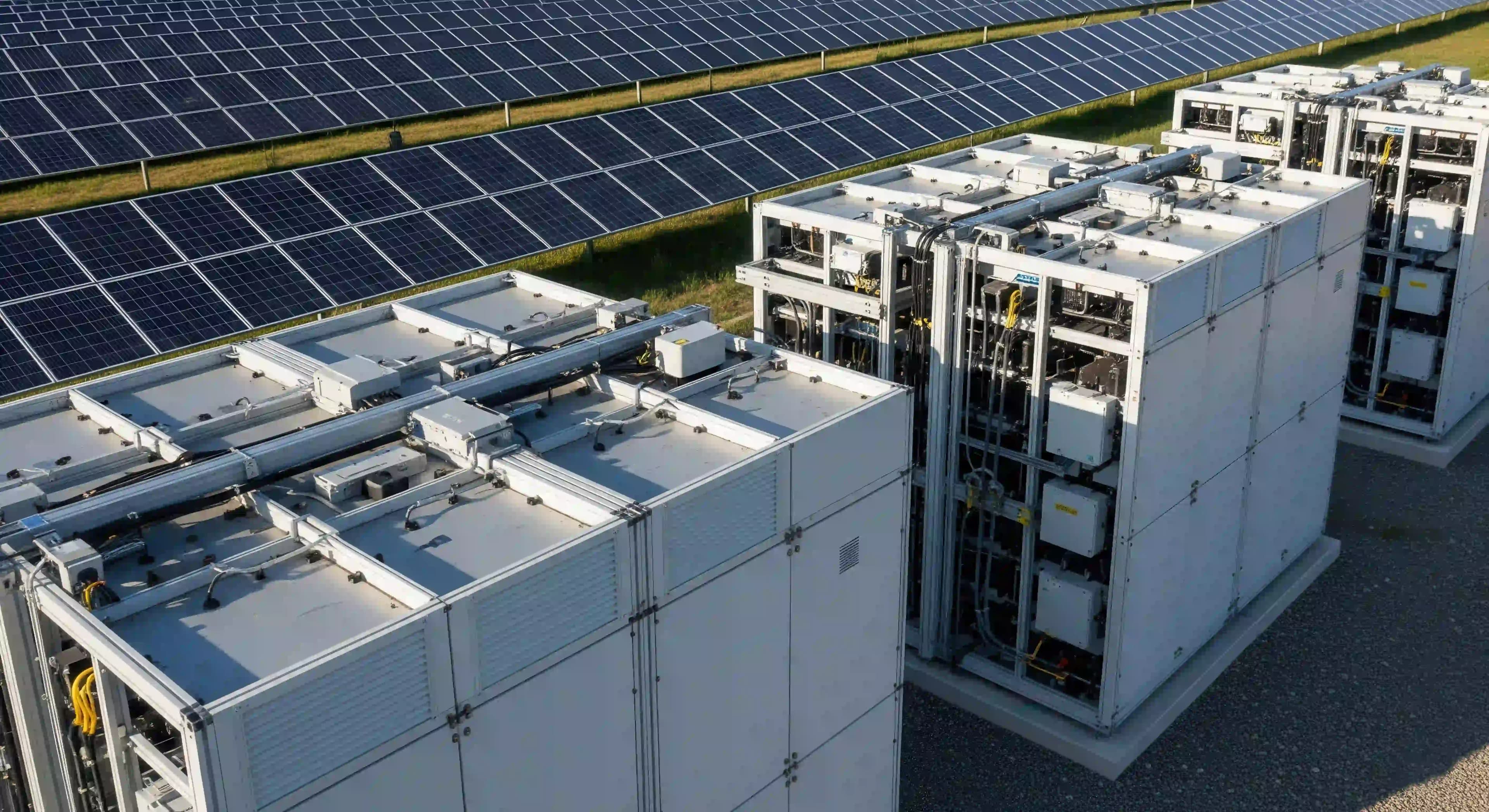
Microgrids Battery Energy Storage
When the grid goes down, a microgrid does not fail. For hospitals, data centers, and factories that cannot afford an outage, the EMS is what holds the lights on and the transition has to be seamless.
A grid outage is an inconvenience for most consumers and a catastrophe for some. A data centre loses thousands of euros per minute and risks data corruption. A hospital faces life-safety consequences. A manufacturing line mid-process scraps an entire batch and may damage equipment. For these sites, grid reliability is not a utility-level concern to be managed through diesel backup and hope — it is an operational requirement that demands an engineered solution. That solution is the microgrid.
A microgrid is a localised energy system that can operate connected to the main grid or independently from it. When the grid is healthy, the microgrid draws and exports power normally. When the grid fails, the microgrid disconnects — islands — and continues to power its critical loads from local generation and battery storage, without interruption. This guide explains how microgrids work, what islanding requires technically, the role of battery storage and the EMS in delivering it, and why the quality of the islanding transition determines whether the microgrid protects the site or merely softens the blow.
What a Microgrid Is
A microgrid combines three elements: local energy resources, controllable loads, and a control system that coordinates them. The local resources typically include battery storage, on-site solar or wind generation, and often a backup generator. The controllable loads are the facility’s electrical demand, which the microgrid can prioritise — keeping critical systems powered while shedding non-essential loads if necessary. The control system, the EMS, is what makes the collection of equipment behave as a coordinated microgrid rather than a set of independent devices.
The defining characteristic of a microgrid is its ability to operate in two modes and transition between them. In grid-connected mode, the microgrid operates as part of the wider network — importing power when local generation is insufficient, exporting surplus, and potentially earning revenue from grid services. In islanded mode, the microgrid is electrically separated from the main grid and operates as a self-contained power system, balancing its own generation and demand in real time. The transition between these modes is where the engineering challenge concentrates.
Grid-Connected vs Islanded Operation
In grid-connected mode, the main grid provides the voltage and frequency reference. The microgrid’s inverters synchronise to that reference and inject or draw power relative to it. This is straightforward — the grid does the hard work of maintaining stability, and the microgrid participates within it.
In islanded mode, there is no external reference. The microgrid must establish and maintain its own voltage and frequency, balancing generation against demand instant by instant. This requires a grid-forming resource — typically the battery storage system operating through a grid-forming inverter — to hold the voltage and frequency reference that every other device in the microgrid synchronises to. The technical foundation for this capability is covered in PowerKonnekt’s guide to grid forming: the same voltage-source control that enables black start is what allows a battery to anchor an islanded microgrid.
The two modes impose opposite demands. Grid-connected operation optimises for economics — minimising energy cost, maximising self-consumption, earning grid-service revenue. Islanded operation optimises for stability and continuity — keeping critical loads powered for as long as the stored energy and local generation allow. The EMS must manage both objectives and, critically, the moment of transition between them.
The Islanding Transition: Why Milliseconds Matter
The most demanding moment in microgrid operation is the transition from grid-connected to islanded mode when the grid fails unexpectedly. The quality of this transition determines whether the site experiences a seamless continuation of power or a disruptive interruption.
When the grid fails, the microgrid must detect the failure, disconnect from the grid at the point of common coupling, and have its grid-forming resource assume the voltage and frequency reference — all fast enough that connected equipment never sees an interruption. For sensitive loads, the tolerance is measured in milliseconds. A data centre’s servers, a hospital’s imaging equipment, a manufacturing line’s control systems — these cannot ride through a gap of more than a few milliseconds without tripping.
This is where the EMS’s control speed becomes a hard requirement rather than a performance metric. The system polls its field devices on millisecond cycles, detects the grid failure through continuous monitoring, and commands the islanding sequence within its control loop. The battery, already operating, transitions from following the grid to forming the island’s reference. Done correctly, the critical loads experience no interruption at all. The same continuous-monitoring and fast-response architecture that underpins frequency regulation — detailed in the frequency regulation guide — is what makes a seamless islanding transition possible.
Technical Note: Seamless Transfer vs Break-Before-Make
Backup systems differ fundamentally in how they handle the transition to island operation. A traditional diesel generator with an automatic transfer switch operates break-before-make: it disconnects from the grid, starts the generator, and reconnects — a process that takes seconds to tens of seconds, during which the site loses power. Sensitive loads require an uninterruptible bridge through this gap, traditionally provided by a separate UPS.
A battery-based microgrid with a grid-forming inverter and a fast EMS can achieve seamless transfer — the battery is already online and assumes the reference within milliseconds, eliminating the gap entirely. This removes the need for a separate UPS layer for many applications and delivers a continuity of supply that generator-only backup cannot match. The differentiator is not the battery; it is the EMS’s ability to detect and execute the transition fast enough.
What a Microgrid Delivers
Microgrid capability addresses several distinct operational and commercial requirements, which is why it has moved from a niche solution for remote sites to a mainstream requirement for critical infrastructure.
Resilience and Business Continuity
The primary value is the ability to continue operating through a grid outage. For critical infrastructure — data centres, hospitals, telecommunications facilities, water treatment, emergency services — this is not optional. For commercial and industrial sites, the cost of downtime (scrapped production, idle labour, missed deliveries, equipment damage) often justifies microgrid investment on resilience grounds alone.
Energy Cost Optimisation in Normal Operation
A microgrid is not idle capital waiting for an outage. In grid-connected mode, the same battery and generation assets that provide islanding capability also reduce energy costs through peak shaving, self-consumption of on-site renewables, and time-of-use optimisation. The microgrid earns its keep daily and provides resilience as a structural benefit. For the demand-charge economics specifically, see PowerKonnekt’s peak shaving guide.
Renewable Integration and Decarbonisation
A microgrid maximises the use of on-site renewable generation by storing surplus and dispatching it when generation falls short — reducing grid dependence and carbon footprint simultaneously. In islanded mode, the EMS coordinates renewable generation with storage to extend the duration the microgrid can sustain itself, managing the variability of solar and wind against the critical load profile.
Grid Services Revenue
When connected, a microgrid’s battery can participate in grid-service markets — frequency regulation, capacity markets, and energy arbitrage — generating revenue from capacity that would otherwise sit reserved for backup. The EMS manages the balance between holding reserve for islanding readiness and monetising available capacity. This stacking logic is the same principle covered in PowerKonnekt’s energy arbitrage guide.
The EMS Role in Microgrid Control
A microgrid is only as capable as the control system that coordinates it. The EMS performs four functions that determine whether the microgrid delivers seamless resilience or merely approximate backup.
Mode management and seamless transition. The EMS continuously monitors grid status, executes the islanding sequence the instant the grid fails, and manages reconnection and resynchronisation when the grid returns — all without manual intervention and fast enough to protect sensitive loads.
Load prioritisation and shedding. In islanded mode, stored energy is finite. The EMS prioritises critical loads and can shed non-essential demand to extend the runtime available for the loads that matter, managing the microgrid’s energy budget against the duration of the outage.
Generation coordination. The EMS coordinates battery storage, solar, wind, and backup generators as a unified system — dispatching each resource optimally, managing the battery’s state of charge against the available local generation, and starting the generator only when stored energy and renewables cannot sustain the critical load. In off-grid mode, the EMS also manages connected generation to prevent overcharging, instructing solar to reduce output once the battery reaches full charge.
Reconnection and resynchronisation. When the grid is restored, the EMS cannot simply close the connection — the islanded microgrid’s voltage and frequency must be synchronised with the returning grid before reconnection, or the resulting transient could damage equipment. The EMS manages this resynchronisation and executes a controlled, seamless return to grid-connected operation.
Frequently Asked Questions
What is a microgrid?
A microgrid is a localised energy system — combining battery storage, on-site generation, and controllable loads under a single control system — that can operate connected to the main grid or independently from it. When the grid fails, the microgrid islands and continues powering its critical loads from local resources without interruption.
What is the difference between a microgrid and a backup generator?
A backup generator provides power during an outage but typically operates break-before-make: the site loses power for seconds to tens of seconds while the generator starts and connects. A battery-based microgrid with a grid-forming inverter achieves seamless transfer — the battery is already online and assumes the voltage reference within milliseconds, so critical loads experience no interruption. A microgrid also generates value in normal operation through energy cost optimisation and grid services, whereas a generator sits idle until needed.
What does islanding mean?
Islanding is the process by which a microgrid disconnects from the main grid and operates as a self-contained power system. In islanded mode, the microgrid establishes and maintains its own voltage and frequency reference — typically through a grid-forming battery inverter — and balances its own generation against demand in real time, without any external grid reference.
How fast does a microgrid switch to island mode?
For a battery-based microgrid with a grid-forming inverter and a fast EMS, the transition can be seamless — measured in milliseconds, fast enough that sensitive loads such as data centre servers or medical equipment experience no interruption. The speed depends on the EMS’s detection and control loop: it must sense the grid failure, disconnect at the point of common coupling, and have the battery assume the reference within the tolerance of the connected loads.
Can a microgrid use solar and wind?
Yes. A microgrid integrates on-site renewable generation alongside battery storage. In grid-connected mode, the EMS maximises self-consumption of renewable output. In islanded mode, it coordinates renewable generation with storage to extend how long the microgrid can sustain itself, managing the variability of solar and wind against the critical load. The battery provides the stable reference that allows variable renewables to operate within the island.
Does a microgrid save money or just provide backup?
Both. The resilience value — continuing to operate through outages — is the primary justification for critical sites. But the same assets reduce energy costs daily through peak shaving, self-consumption, and time-of-use optimisation, and can earn grid-service revenue when connected. A well-designed microgrid is a productive asset that provides resilience as a structural benefit, not idle capital waiting for an outage.
How PowerKonnekt Approaches This
Microgrid capability is a native function of the PowerKonnekt EMS, enabling facilities to operate independently during grid outages while maintaining critical load continuity. The EMS coordinates solar, wind, BESS, and generators as a unified system, manages the islanding transition through continuous millisecond-level monitoring, prioritises and sheds loads to extend islanded runtime, and executes controlled resynchronisation and reconnection when the grid returns.
The grid-forming control that anchors an islanded microgrid is the same capability PowerKonnekt deploys at utility scale for black start — proven on the 100 MW Göktepe and Büyükkışla projects. The ability to establish a voltage and frequency reference without an external grid, coordinate it across multiple converters, and sequence the energisation of a network is the technical foundation that islanding shares with black start, explained in full in the grid forming guide.
In off-grid operation, the PowerKonnekt EMS manages connected energy sources to prevent overcharging — for example, instructing a connected solar plant to reduce generation once the battery reaches full charge, protecting the battery while maximising renewable utilisation within the island. The Başkent OSB deployment in Ankara demonstrates off-grid operational capability in practice, combining EV charging, on-site solar, and factory load under a single EMS with stable off-grid operation when required and solar-first energy usage.