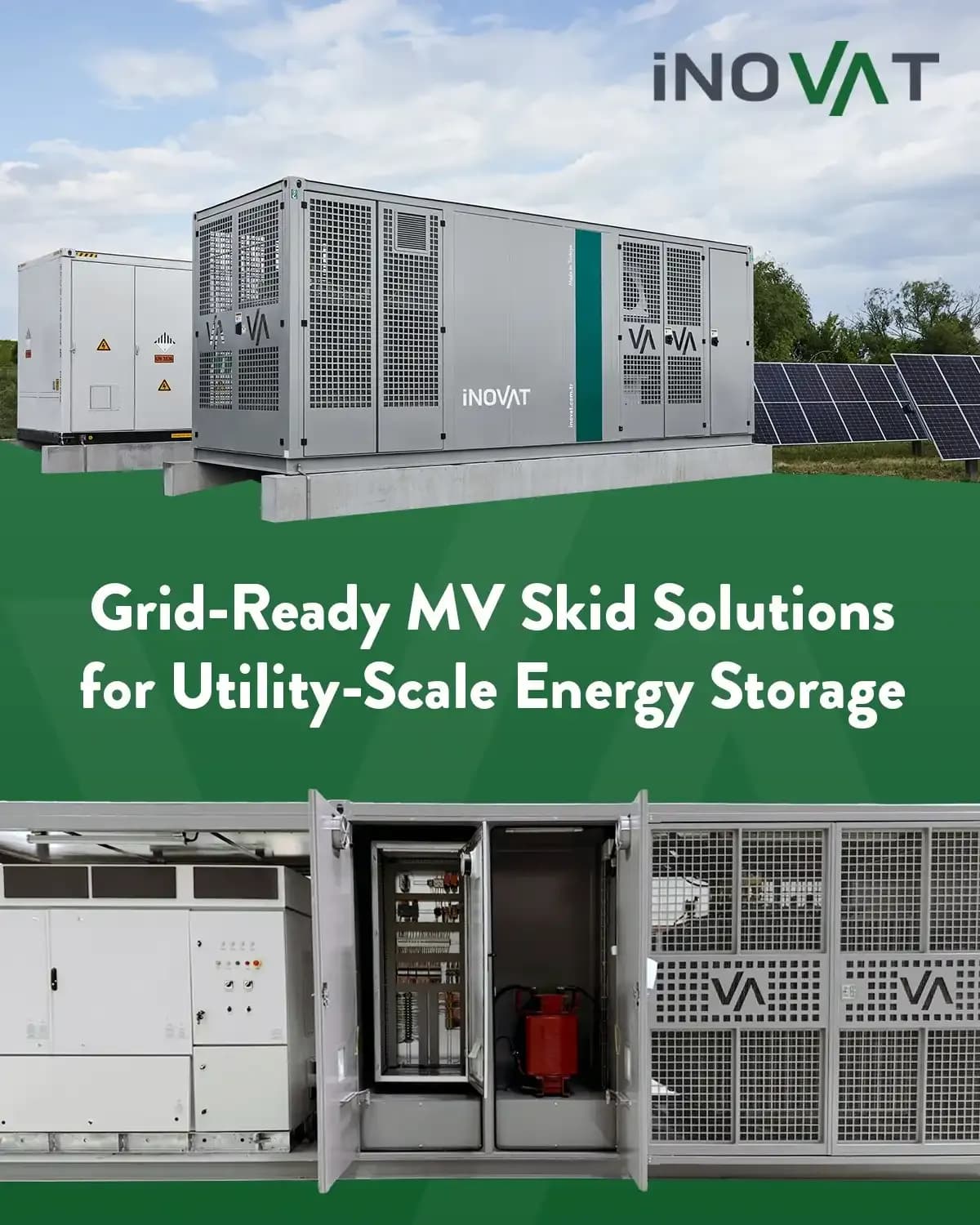
Medium-Voltage Skid
A technical guide to medium-voltage skids for utility-scale BESS: PCS, transformer and switchgear selection, C-rate sizing, derating and IEC 62271-212.
Almost every conversation about a battery energy storage project starts with two numbers: megawatts and megawatt-hours. Those two figures dominate the term sheet, the press release and the investment committee deck. What they do not describe is the equipment that stands between the battery enclosures and the grid connection point — the transformer, the power conversion system, the medium-voltage switchgear, the protection relays and the auxiliary supplies that together determine whether the plant can legally and physically export a single kilowatt-hour.
That equipment is increasingly delivered as a single factory-assembled unit called an MV skid. It is one of the least discussed and most schedule-critical components in the entire project, and the decisions made when specifying it constrain everything downstream: how many battery containers a block can hold, which grid codes the plant can satisfy, how long commissioning takes, and how much civil work the site actually requires.
This article explains what an MV skid is, what sits inside it, how it differs from an e-house or a conventional prefabricated substation, how to size one against a given battery configuration, and which specification points matter most for European grid connections. It is written for developers, EPC engineers and procurement teams who are past the feasibility stage and into equipment selection.
What an MV Skid Actually Is
An MV skid — also marketed as a power skid, MV station, step-up skid station or compact conversion block — is a rigid steel base carrying the complete low-voltage-to-medium-voltage conversion chain for a section of a power plant. Everything is mounted, wired, interlocked and tested in a factory, then shipped as one liftable assembly and set on a prepared foundation.
The skid is the point where direct current from the battery becomes grid-ready alternating current. The power conversion system takes high-current DC from the battery enclosures and inverts it to low-voltage AC, typically somewhere between 480 V and 690 V. The step-up transformer then raises that to medium voltage — usually between 11 kV and 36 kV in European networks — so the energy can travel through the site collection system to the point of interconnection without ruinous cable losses.
What makes the skid concept different from simply buying the same components separately is the interconnection. On a conventional site, the cabling, busbar bridges, protection wiring and interlocking between inverter, transformer and switchgear are all built in the field, by technicians working in weather, at height, under schedule pressure, on a plant that has never been energised. On a skid, those interfaces are factory-made and factory-proven. The site work reduces to a foundation, incoming DC cables, outgoing MV cables, earthing and communications.
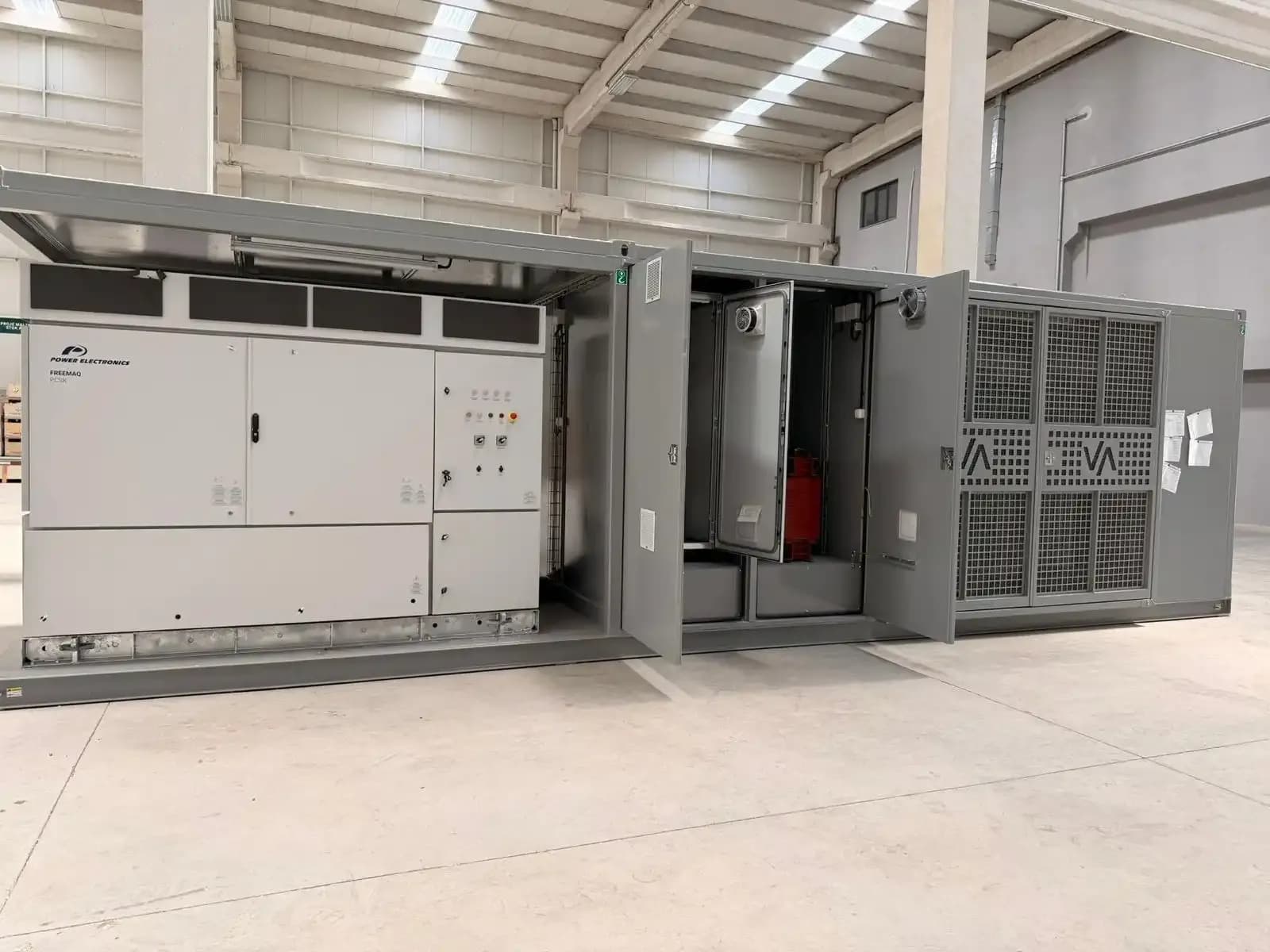
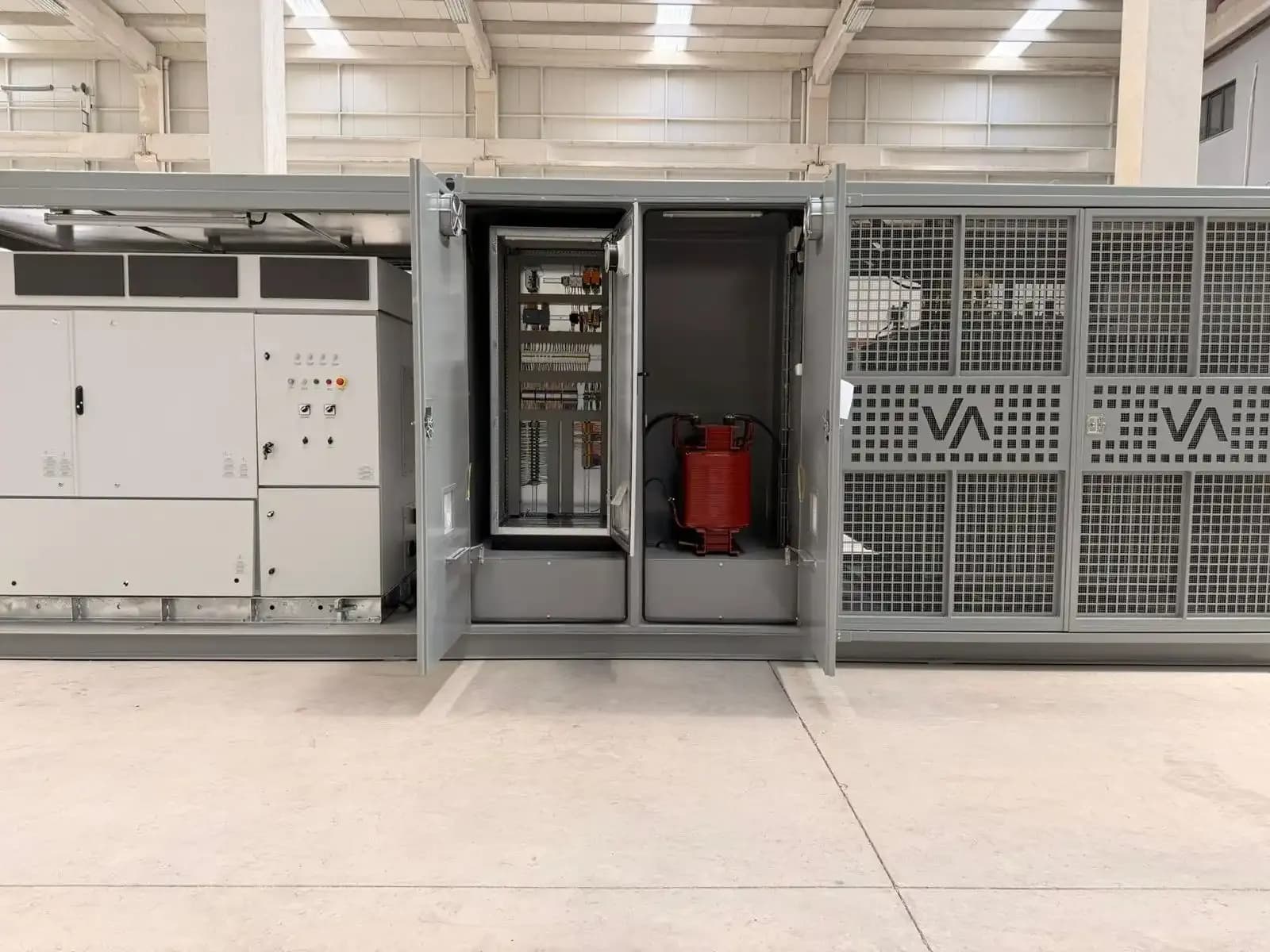
Inside the Skid: The Five Functional Blocks
Strip away the enclosure and every MV skid resolves into the same five functional groups, regardless of manufacturer.
1. The power conversion system
The PCS is the largest single cost item and the component that sets the skid's power rating. Configurations vary widely: a single high-capacity central inverter, two mid-range units, or three to four modular units mounted side by side. The choice is not cosmetic. A skid built around one inverter with one DC input behaves very differently from a skid built around four modular inverters with four independent DC inputs, because the number of separate DC inputs directly determines how many battery containers can be connected to that block and how the plant degrades when one unit faults.
2. The step-up transformer
Almost always an oil-immersed unit with ONAN cooling — natural oil circulation, natural air cooling, no pumps or fans to fail. The vector group is typically Dy11, giving the delta-connected MV winding and star-connected LV winding with a 30-degree phase displacement that most European distribution networks expect. Where a skid carries two independent LV inverter groups, a three-winding Dy11y11 configuration lets both feed a single MV terminal without interaction between them.
Transformer protection deserves more attention than it usually gets in procurement. A properly specified unit carries a protection relay monitoring oil pressure, two-stage temperature and gas evolution, plus dielectric level monitoring and optional PT100 winding sensors. Beneath it sits an oil retention tank — galvanised steel, optionally fitted with a hydrocarbon filter — which captures any leak before it reaches the ground. That tank is not an electrical component and it is frequently value-engineered out; environmental permitting authorities across the EU increasingly disagree with that decision.
3. The medium-voltage switchgear
Usually a ring main unit arrangement built from SF6-insulated functional units: an incoming feeder, a transformer circuit-breaker cubicle, and often a second feeder so the block can be looped into the collection ring rather than radially spurred. Ratings of 630 A at 16 kA for one second are common, with 20 kA and 25 kA available where the network fault level demands it. The internal arc classification — an IAC rating such as A FLR 16 kA for one second, meaning arc-tested on the front, lateral and rear faces with restricted access — is the number that determines whether personnel can safely stand beside the unit during a fault.
4. Protection, control and auxiliaries
A 24 V DC battery rectifier keeps protection relays and switchgear motors alive when the plant is dead, which is exactly when they matter most. Larger configurations add an auxiliary transformer — a 200 kVA 0.69/0.4 kV unit is a typical selection — to supply battery container HVAC, lighting and control loads from the plant itself rather than an external service connection. An optional UPS extends ride-through for the control layer. Auxiliary load is not trivial: a single liquid-cooled battery container can draw 25 kW to 62 kW for its own thermal management, and four containers per block adds up quickly.
5. The base, enclosure and interlocking
The steel base is what makes the assembly a skid rather than a collection of cabinets. It fixes the alignment between components permanently, carries the lifting points, and gives the whole assembly a defined service envelope. Mechanical interlocking prevents any door reaching a live compartment from opening in the wrong sequence — the single most important safety feature in the package and the one that gets compromised when interconnections are field-built.
Skid, E-House or Prefabricated Substation?
These three terms circulate as near-synonyms in tender documents and they are not the same thing. The distinction matters commercially, because it determines cost, transport logistics and how much of the plant a technician can service while standing inside a structure versus outside one.
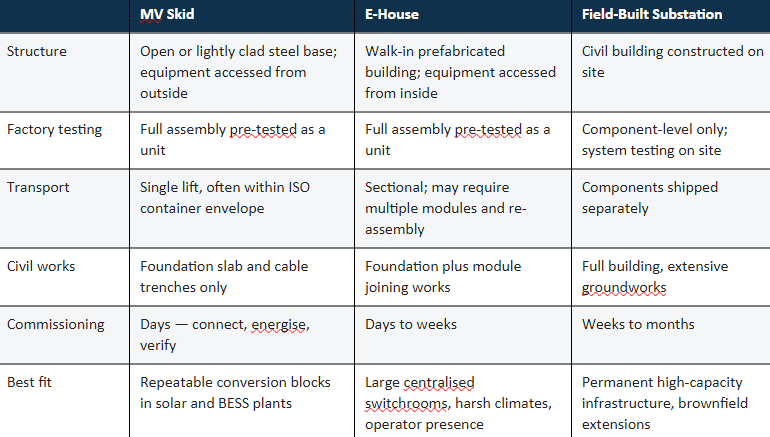
The practical logic behind the skid approach is repeatability. A utility-scale storage plant is not one large machine; it is a set of identical conversion blocks replicated across a field. Once the block is defined and type-tested, adding capacity is a procurement exercise rather than an engineering exercise. An e-house, by contrast, tends to serve a centralised function — a single point where operators need to walk in and work — and does not replicate as economically.
Sizing the Skid Against the Battery: Where Projects Go Wrong
The most common specification error is treating skid rating and battery energy as independent variables. They are not. The relationship runs through the battery's C-rate, and getting it wrong produces either stranded battery capacity or an oversized transformer that never sees its nameplate load.
A container's C-rate expresses how fast it can deliver its stored energy. A 1C container discharges its full rated energy in roughly one hour; a 0.5C container takes two. So a container rated at approximately 3,800 kWh at 1C presents around 3,800 kW of power to the conversion equipment, while a container rated at roughly 4,100 kWh at 0.5C presents only about 2,000 kW. Same footprint, similar energy, half the power. The skid must be sized to the power, not the energy — and the number of containers per skid follows directly from that arithmetic.
The second sizing variable is ambient temperature. A skid rated at, say, 4,390 kVA at 40 °C will typically derate to around 4,075 kVA at 50 °C, with further derating above that. In Southern Europe, the Balkans, Türkiye and much of the Mediterranean basin, summer ambient conditions sit close to the derating threshold for a meaningful part of the year — which is also, inconveniently, when peak-shaving and arbitrage spreads are widest. Specifying against the 40 °C figure and operating in a 45 °C environment quietly removes several per cent of revenue from the financial model.
Altitude is the third. Standard ratings generally apply up to 1,000 metres above sea level; above that, reduced air density degrades both dielectric strength and cooling performance, and a specific derating factor must be applied. Plenty of Alpine, Anatolian and Iberian sites sit above that line.
The European Specification Checklist
For a project connecting to a European distribution network, a handful of parameters determine whether the skid is fit for the connection at all.
- MV voltage class. Continental European distribution networks cluster around 20 kV and 30 kV, with equipment commonly specified to 24 kV or 36 kV insulation classes. Türkiye and several neighbouring markets standardise on 36 kV. A skid quoted only in a 24 kV class cannot be redeployed to a 33 kV network without changing the switchgear.
- LV voltage. The inverter output voltage — commonly 480 V, 600 V, 630 V, 660 V or 690 V — must match the transformer LV winding exactly. This is the single most frequent source of incompatibility when a developer changes PCS supplier mid-project.
- Short-circuit withstand. The network operator will state a fault level at the connection point. The switchgear rating must exceed it with margin, and the number is not negotiable after connection agreement.
- Ingress protection. IP54 on the transformer compartment is a reasonable baseline for outdoor European installation; coastal and desert sites warrant more.
- Standards compliance, stated explicitly. IEC 62271-212, IEC 62271-200, IEC 60076 and IEC 61439-1 should appear by number on the datasheet, not as a generic claim of conformity.
- Fire and containment provisions. Oil retention with hydrocarbon filtration, and a defined fire-suppression interface, are increasingly required by permitting authorities rather than merely recommended.
One further point is worth raising in tender clarifications: whether the supplier is brand-agnostic on the conversion equipment. A skid designed around a single inverter manufacturer locks the project into that supply chain for the life of the asset. A platform engineered to accept conversion systems from several Tier 1 manufacturers — and battery containers from several cell suppliers — preserves negotiating leverage and protects the project against a single vendor's lead times, insolvency or product discontinuation.
Where the EMS Meets the Steel
An MV skid is a competent piece of power engineering and a completely passive one. It converts, steps up, protects and isolates. It does not decide anything. Whether the plant charges at midday or discharges into the evening peak, whether it holds state-of-charge headroom for a frequency product, whether it curtails to respect a connection limit or bids into an intraday window — none of that lives in the skid.
Those decisions belong to the energy management layer, and the interface between the two is where a surprising number of projects underperform. The EMS issues setpoints; the conversion system executes them; the protection layer inside the skid can override both. When the command hierarchy between market platform, EMS, plant controller and local protection is not explicitly defined during design, the result is a plant that is electrically sound and commercially disappointing. We have covered that hierarchy in detail in our breakdown of EMS, BMS, SCADA and PPC responsibilities.
The relationship also runs in the other direction. Advanced grid services impose requirements back onto the hardware. Grid-forming operation, for instance, requires the conversion equipment to behave as a voltage source rather than a current source, and demands state-of-charge headroom that the EMS must reserve continuously — a constraint explored in our article on grid-forming BESS. Reactive power support, voltage regulation and black start sequencing all depend on capabilities that must be present in the skid and orchestrated from above it. Specifying the hardware without knowing which grid services the plant intends to sell is how projects discover, after commissioning, that a revenue stream in the model is not technically available.
Questions Worth Asking Before You Sign
- What is the rating at the ambient temperature my site actually experiences, not at 40 °C?
- How many independent DC inputs does the conversion system have, and how many battery containers does that allow per skid?
- Which LV winding voltages are available, and what happens to the quote if I change PCS supplier?
- Is the assembly type-tested to IEC 62271-212 as a unit, or are the components individually certified and assembled?
- What is the internal arc classification, and on which faces was it tested?
- Is oil containment included, and does it meet the environmental requirements of my permitting authority?
- Which battery container models has this skid actually been commissioned with, and can I speak to a reference project?
- What auxiliary power provision is included, and does it cover the thermal management load of my container selection?
Conclusion
The MV skid rarely appears in a project narrative. It is not the battery, it is not the software, and it does not photograph well. But it is the component that converts a warehouse full of cells into a licensed generator, and its specification quietly fixes the boundaries of what the plant can do commercially for the next twenty years.
The parameters that matter are unglamorous and specific: the derated rating at real ambient temperature, the number of DC inputs, the LV winding voltage, the fault withstand level, the arc classification, and whether the assembly is genuinely type-tested rather than merely assembled from certified parts. Get those right and the plant commissions in days. Get them wrong and the project discovers its limits after the connection agreement is signed, when the options are expensive.
How PowerKonnekt Approaches This
PowerKonnekt is the energy management layer, and our position on hardware is deliberate: the control platform is brand-agnostic, so the conversion equipment, battery chemistry and switchgear supplier are project decisions rather than platform constraints. In practice that means the EMS integrates with the conversion systems most commonly found on European MV skids and with battery containers across the major cell suppliers, using the protocol stack the site already speaks. What we bring to the skid conversation is the layer above it — dispatch logic, market participation, grid-service orchestration and the state-of-charge management that turns a correctly specified conversion block into a revenue-generating asset. If you are specifying balance of plant for a utility-scale project, our utility-scale EMS solutions page sets out the control-side requirements worth designing for from the start, and the technical team is available for a two-week evaluation at powerkonnekt.com/contact.
Frequently Asked Questions
What is an MV skid in a battery energy storage system?
An MV skid is a factory-assembled steel base carrying the complete conversion chain between the battery enclosures and the medium-voltage grid — typically a power conversion system, a step-up transformer, medium-voltage switchgear, protection relays and auxiliary supplies. It arrives pre-wired and pre-tested, so site work reduces to a foundation, cable terminations and earthing.
What is the difference between an MV skid and an e-house?
An MV skid is an open or lightly clad equipment base serviced from outside; an e-house is a walk-in prefabricated building serviced from inside. Skids suit repeatable conversion blocks replicated across a solar or storage plant. E-houses suit centralised switchrooms where operators need to work indoors, or sites with severe environmental conditions.
How do I size an MV skid for my battery containers?
Size against power, not energy. Multiply each container's rated energy by its C-rate to get its power contribution — a 4,000 kWh container at 0.5C presents roughly 2,000 kW, while a similar container at 1C presents around 4,000 kW. Then confirm the number of independent DC inputs on the conversion system, because that sets how many containers a single skid can actually serve.
Which standards apply to an MV skid?
The primary reference is IEC 62271-212, covering Compact Equipment Assembly for Distribution Substation for AC voltages up to 52 kV. Supporting standards include IEC 62271-200 for metal-enclosed MV switchgear, IEC 60076 for power transformers and IEC 61439-1 for low-voltage assemblies. Ask whether the assembly is type-tested as a unit rather than assembled from separately certified components.
What MV voltage should I specify in Europe?
It depends on the distribution network at the point of interconnection. Continental European networks commonly operate at 20 kV and 30 kV, with equipment specified to 24 kV or 36 kV insulation classes; Türkiye and several neighbouring markets standardise on 36 kV. Confirm the voltage and the fault level with the network operator before finalising switchgear ratings, because retrofitting a higher class is not economical.
Does ambient temperature affect MV skid capacity?
Yes, significantly. Ratings are typically quoted at 40 °C, with derating applied at 50 °C and further reduction above that. Altitude matters too — standard ratings generally hold to 1,000 metres, with derating beyond. For Southern European and Mediterranean sites, specifying against the 40 °C figure alone will overstate available capacity during exactly the summer hours when energy prices are highest.