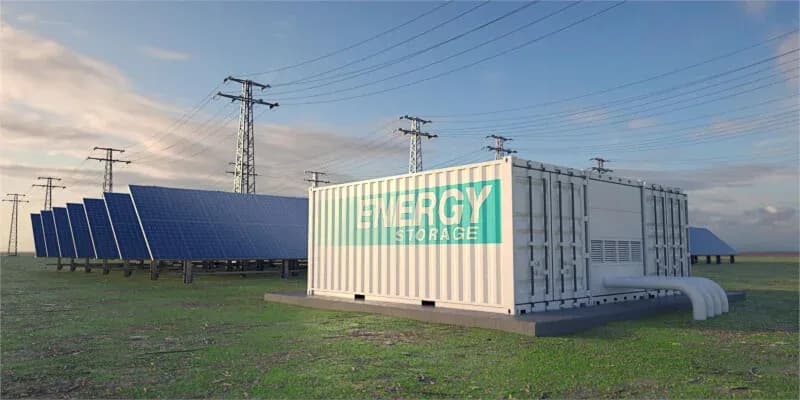
How to Size BESS
Undersize it and the service fails. Oversize it and the returns collapse. The arithmetic of battery sizing is well documented. What is rarely acknowledged is that every sizing calculation quietly assumes a dispatch strategy, and most assume a poor one.
Battery storage is specified with two numbers: power, measured in megawatts, and energy, measured in megawatt-hours. Almost every costly mistake in storage project development traces back to getting the relationship between those two numbers wrong. A system with insufficient power cannot deliver the service it was bought for, no matter how much energy it holds. A system with excess energy capacity delivers the service perfectly while destroying the project's rate of return. Neither error is recoverable after commissioning.
This guide covers how power, energy, and duration relate to each other, the deratings that separate nameplate capacity from usable capacity, the grid constraints that frequently override the calculation entirely, how sizing differs across the major use cases, and — the part most sizing guides omit — how the control strategy changes the answer. For the foundational role the control layer plays across a storage project, see PowerKonnekt's complete BESS EMS guide.
Power vs Energy: The Two Numbers That Define a Battery
The most useful analogy is plumbing. Power is the size of the tap: how fast energy can flow in or out at any instant. Energy is the size of the tub: how much can be held in total. A large tap on a small tub empties quickly. A small tap on a large tub cannot deliver quickly, however much it stores.
Power (MW) Is Set by the Largest Instantaneous Demand
Power rating is determined by the most demanding single service the system must deliver at any moment. For a frequency regulation asset, it is the contracted response. For a peak-shaving installation, it is the difference between the site's peak draw and its target ceiling. Power drives the sizing of the power conversion system, the transformer, and the grid connection, and these are among the most expensive components in the build.
Energy (MWh) Is Power Multiplied by Duration
Energy capacity follows from how long the system must sustain its rated power. A 10 MW system that must hold output for two hours needs 20 MWh. The same 10 MW system supporting a four-hour discharge needs 40 MWh. Energy drives cell count, container count, and land area.
Duration and C-rate: The Ratio That Connects Them
Duration is energy divided by power, expressed in hours, and its inverse is the C-rate. A system discharging its full rated energy in one hour operates at 1C; over two hours, 0.5C; over four hours, 0.25C. A thirty-minute frequency response application runs at 2C. In practice,0.5C is common for two-hour duty and 1C for one-hour regulation duty, while renewable shifting over two to four hours typically sits between 0.25C and 0.5C. Above 1C, thermal and degradation penalties rise sharply, which is why high C-rates are usually reserved for genuine short-duration power applications rather than being adopted as a default.
C-rate is not only a battery parameter. It propagates through cell current, busbar sizing, thermal management, power conversion matching, and warranty terms. A higher C-rate means more expensive cells, stricter thermal design, and real engineering consequences — which is why some vendors quietly favour low-C configurations that produce an impressive-looking megawatt-hour number with cheaper cells and easier cooling, while delivering less usable power than the buyer assumed. The degradation consequences of aggressive C-rates are covered in PowerKonnekt's guide to battery degradation and lifetime.
Why Four Hours Became the Utility Default
Across utility-scale projects,four-hour duration has become the de facto standard, for a reason rooted in cost structure rather than physics. Many of the largest costs in a storage project — the power conversion system, transformer, and interconnection — scale with power rather than energy. Once that power infrastructure is paid for, adding hours of energy becomes progressively cheaper at the margin. Four hours also captures the majority of daily arbitrage spreads and qualifies for capacity credit in most markets. A 200 MW inverter on a four-hour build delivers 800 MWh per cycle. Durations of one to six hours are all deployed, but two-hour and four-hour configurations dominate.
From Nameplate to Usable: The Deratings That Bite
The capacity written on the datasheet is not the capacity the project delivers. Four separate deratings sit between nameplate and contracted usable energy, and each one is routinely underestimated in early-stage sizing.
The State-of-Charge Window
No battery operates between zero and one hundred percent. Systems run within a defined state-of-charge window —typically 10–90% for nickel-based chemistries and 5–95% for lithium iron phosphate— and that window, expressed as a percentage, is the usable depth of discharge. A system with a 90% usable window immediately loses a tenth of its nameplate before any other factor applies. The relationship between operating window and battery life is covered in the guide to state of charge, depth of discharge, and cycle life.
Round-Trip Efficiency
Energy is lost in conversion. AC round-trip efficiency for modern systems runsbetween roughly 88% and 94%, meaning that delivering a contracted quantity of energy requires charging with meaningfully more. Combined with depth-of-discharge limits, this typically meansoversizing by around 8% to 12%simply to deliver the contracted usable megawatt-hours on day one. The efficiency dimension is explored further in the guide to maximising energy storage efficiency.
Auxiliary Load
A battery container is not a passive box. Thermal management, HVAC, controls, and fire suppression all consume power continuously, and this parasitic load is frequently omitted from preliminary designs. A10% to 15% bufferfor auxiliary consumption is a reasonable planning assumption, with the exact figure depending on climate and container design. In hot climates, cooling load during summer peak periods can be substantial precisely when the system is most needed.
End-of-Life Capacity and the Augmentation Decision
This is the derating that separates experienced developers from first-time ones. A system sized to deliver its contracted energy in year one will fall short by year five or ten, because cells degrade. The industry convention treats80% of nameplate as the end-of-life threshold, and lithium iron phosphate typically fades a couple of percent per year under well-managed operation.Size for end-of-life capacity, not beginning-of-life capacity.
There are two ways to hold contracted capacity across a fifteen to twenty year offtake: oversize at the start, installing more capacity than needed so that degraded capacity still meets the contract late in life, or plan augmentation, adding cells partway through the project term. Each has a different capital profile, and the choice is a financial decision that belongs in the project model from the beginning rather than an engineering afterthought discovered in year six.
Availability and Temperature Margins
Grid-scale systems typically carry availability guarantees in the region of 95% to 98%, which may require additional capacity or redundant strings to satisfy when individual components are offline for maintenance. Capacity and power both derate at low temperatures, so cold-climate installations need an additional thermal margin. Neither factor is large individually; together they can consume the margin a designer thought they had.
The Constraint That Overrides the Calculation: Grid Connection
A sizing exercise can produce a technically optimal answer that is entirely undeliverable, because the grid connection sets a hard ceiling the calculation never sees.
The interconnection limit at the point of common coupling is frequently the binding constraint on power rating, and it is set by the network operator rather than by the project's economics. In constrained networks, the connection capacity a project can actually secure may be a fraction of what its business case would justify. Transformer capacity imposes a further practical limit: charging power is generally kept within roughly 70% to 80% of transformer rating, and total system capacity is often held within a similar proportion of available infrastructure.
The practical consequence is that sizing should begin with the connection constraint, not end with it. Establishing what the network will actually permit, before optimising power and energy against the revenue model, avoids designing a system that cannot be built. Where the connection is the binding constraint, the design question inverts: rather than asking how much capacity the business case supports, the question becomes how much value can be extracted from the connection capacity available — which is a control and dispatch question as much as a hardware one.
Use-Case-Driven Sizing
There is no universal correct ratio. The right power-to-energy relationship follows directly from what the asset is being paid to do, and multi-service assets must satisfy the envelope of all their obligations rather than the sum of them.
Frequency Regulation: Power-Led, Short Duration
Frequency services demand high power delivered quickly, with modest energy behind it. One-hour regulation duty at 1C is a common configuration. The complication is symmetry: symmetric frequency containment requires the asset to be able to both absorb and inject at contracted power at any moment, which means state of charge must be held in a mid-range band rather than run to either extreme. The usable window for a frequency-regulating asset is therefore narrower than its physical window, and that reserved band must be reflected in sizing. The service requirements are covered in detail in the guide to FCR and frequency regulation.
Energy Arbitrage: Energy-Led, Two to Four Hours and Beyond
Arbitrage is about moving volume between price periods, so duration drives revenue. Two-hour and four-hour configurations dominate because they capture the bulk of daily price spreads. Longer durations capture more of the extremes but face diminishing returns as the additional hours address progressively narrower spreads. The economics of spread capture, including the efficiency and degradation thresholds a spread must clear to be worth taking, are covered in the guide to energy arbitrage with battery storage.
Peak Shaving: Power-Led, Burst Duration
Peak shaving is driven by kilowatts, not kilowatt-hours. Demand charges are assessed on short intervals, so the system must deliver enough instantaneous power to hold the site below its threshold during those windows — but only for the duration of the spike. A high-power, short-duration configuration is often more capital-efficient than a larger, slower system for genuinely short peaks. Because energy disappears rapidly at high power, averaged consumption data systematically understates the requirement. The full sizing framework for industrial demand management is set out in PowerKonnekt's guide to peak shaving for factories.
Renewable Firming and Co-Location: Generation-Profile-Led
When storage is paired with solar or wind, duration is set by the shape and persistence of generation deviations rather than by a price curve. Longer duration sustains a target output through more prolonged shortfalls, improving firming performance materially. Configurations from one to six hours are deployed, with two and four hours most common. The sizing input here is the generation time series, not a single peak figure, and the analysis must consider how long the asset needs to hold output when generation underperforms forecast.
Backup and Microgrid: Outage-Duration-Led
For resilience applications, energy capacity is set by how long critical load must be carried through an outage, and power by the magnitude of that critical load. Load prioritisation changes the answer substantially: a facility that can shed non-essential load during an island extends its runtime without any additional capacity, which is a control capability rather than a hardware one. Islanding and resilience sizing considerations are covered in the guide to microgrids and battery energy storage.
Why the EMS Changes the Answer
Every sizing calculation contains a hidden assumption about how the battery will be operated. Change the dispatch strategy and the required capacity changes with it. This is the part of sizing that datasheets and calculators cannot capture, and it is where projects most often either overspend or underperform.
Dynamic Modulation Versus Fixed Dispatch
A control system that dispatches at full rated power whenever it acts consumes far more energy per event than one that modulates output continuously to match only the actual excess above the target threshold. Two systems can deliver the identical outcome at the meter while consuming materially different quantities of stored energy, because one is tracking the requirement precisely and the other is applying a blunt instrument. Sized for the blunt approach, the project buys capacity it would not have needed with a control layer capable of proportional response.
The Rebound Peak: A Control Failure Blamed on Sizing
One of the most common and least discussed failure modes in demand management is the rebound peak. The battery discharges successfully to shave a demand spike, then immediately recharges at high power to restore state of charge — and that recharge creates a new peak, sometimes larger than the one just avoided, entirely negating the saving. The project appears to have failed on sizing. It has actually failed on control. No amount of additional capacity fixes it; ramp-controlled, price-aware, and demand-aware recharging does. A control layer without ramp management is a liability regardless of how the system is sized.
Multi-Service Stacking Changes the Constraint Set
When an asset serves several revenue streams, naïve sizing adds the requirements together and produces a system nobody can afford. In reality the binding constraint is usually the state-of-charge reserve that must be preserved for the highest-priority obligation, with remaining capacity available to other services. An EMS capable of managing concurrent obligations — holding a frequency reserve while arbitraging the headroom, for instance — allows the project to size for the envelope of its commitments rather than their sum. That capability is worth real megawatt-hours of avoided capital. The stacking logic across services is discussed in the guide to virtual power plants and aggregation.
Data Quality Determines Sizing Quality
Sizing is only as good as the load data behind it. Demand charges in European markets are assessed onfifteen-minute intervals; monthly billing summaries and averaged consumption figures smooth away exactly the spikes the system is being sized to address. Sizing from smoothed data reliably produces an undersized power rating and an oversized energy rating — the worst combination, delivering high capital cost and poor performance simultaneously. Interval-level measurement is a precondition for a credible sizing exercise, and it is the same measurement infrastructure the EMS relies on in operation.
Frequently Asked Questions
What size battery do I need?
Start from the service. Define the maximum instantaneous power the system must deliver, then the duration it must sustain that power, which gives energy capacity. Apply deratings for the usable state-of-charge window, round-trip efficiency, auxiliary load, and end-of-life capacity retention, then check the result against the grid connection limit, which frequently caps the answer. Interval-level load data is essential; averaged data produces systematically wrong results.
What is the difference between kW and kWh in a battery system?
Kilowatts measure power, the rate at which the system can deliver or absorb energy at any instant. Kilowatt-hours measure energy, the total quantity stored. Power determines whether the system can meet a demand spike; energy determines how long it can sustain output. Dividing energy by power gives duration in hours, and the inverse of duration is the C-rate.
Why is four-hour duration the standard for utility projects?
Because major costs such as the power conversion system, transformer, and interconnection scale with power rather than energy, additional hours of energy become cheaper at the margin once the power infrastructure is committed. Four hours also captures most daily arbitrage spreads and qualifies for capacity credit in many markets, which makes it the point where marginal cost and marginal revenue align for a large share of projects.
Should I oversize the system or plan augmentation?
Both are valid approaches to holding contracted capacity across a long offtake as cells degrade. Oversizing installs surplus capacity at the outset so degraded capacity still satisfies the contract late in life; augmentation adds cells partway through the term. The decision is financial rather than technical, driven by capital cost profile, cost-of-capital assumptions, and expectations about future cell prices, and it belongs in the project model from the start.
How much larger than usable capacity should nameplate be?
Round-trip efficiency and depth-of-discharge limits alone typically require oversizing by roughly 8% to 12% to deliver contracted usable energy on day one. Adding auxiliary load and end-of-life capacity retention, the gap between headline requirement and installed nameplate commonly reaches 40% to 50% for a long-duration contract. Designing to beginning-of-life capacity is the most frequent and most expensive sizing error.
Does the control system affect what size battery I need?
Substantially. A control layer that modulates output proportionally to the actual requirement uses less stored energy per event than one dispatching at full rated power, so it delivers the same result from less capacity. It also prevents failure modes commonly misattributed to sizing, such as rebound peaks created by uncontrolled recharging after a shaving event. For multi-service assets, an EMS able to manage concurrent obligations allows sizing for the envelope of commitments rather than their sum.
How PowerKonnekt Approaches BESS Sizing
PowerKonnekt is brought into sizing conversations because the control layer materially changes the hardware answer. The EMS dispatches proportionally rather than in blunt full-power steps, modulating output continuously against the actual requirement on a20-millisecond control loop— delivering the contracted outcome from less stored energy per event than fixed-dispatch control requires. Over the design of a project, that difference is measured in megawatt-hours of avoided capital.
Ramp-managed recharging prevents the rebound peak that undermines demand-management projects: the EMS restores state of charge under explicit power and price constraints rather than pulling maximum available power the moment a discharge event ends.Peak limitingandload followingoperate as automatic functions with configurable thresholds, so the system tracks the site's real behaviour rather than executing a fixed schedule that assumes a load profile which never quite materialises.
For assets serving multiple revenue streams,base power allocationring-fences the capacity committed to frequency services while the remainder earns from arbitrage or demand management, allowing a project to size against the envelope of its obligations instead of their sum.SoH forecastingandwarranty trackingprotect the end-of-life capacity assumption the entire sizing model depends on, operating the system within manufacturer limits and maintaining auditable records — which is what makes an augmentation plan a controlled decision rather than an emergency. The degradation mechanics behind that assumption are set out in the guide to battery degradation and lifetime.
Because the platform is hardware-agnostic across battery and power conversion manufacturers, sizing decisions can be made on cost and technical merit rather than on control-system compatibility, and the same EMS runs whatever configuration the project settles on. For utility-scale project sizing and grid-service design, see the utility-scale EMS solutions; for commercial and industrial applications, see the C&I EMS solutions. To review a sizing model against real dispatch behaviour before procurement, contact the technical team at powerkonnekt.com/contact.