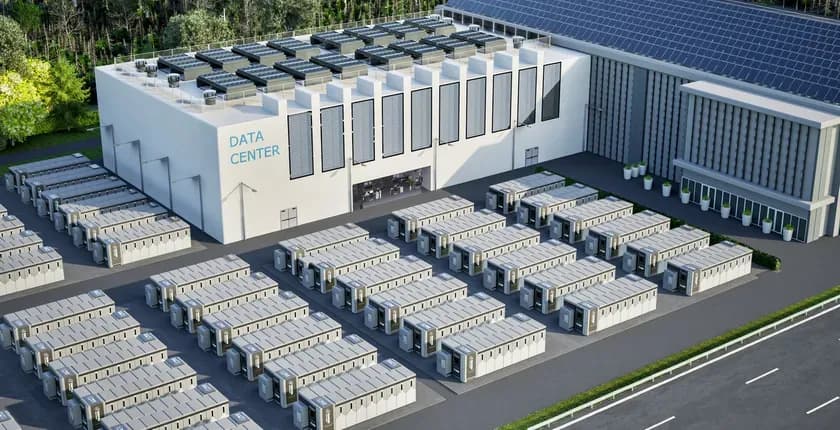
Battery Storage for Data Centers
A data center can be built in 18 months. The grid connection it needs can take ten years. Battery storage is how developers close that gap. EMS is what makes co-located storage behave like the infrastructure a data center depends on.
The artificial intelligence boom has collided with a hard physical limit: the electrical grid cannot connect new load fast enough. Across Europe, data centre developers hold permitted sites and purchased land that cannot reach commercial operation because the wires and substations to power them do not yet exist. The mismatch between how fast a data centre can be built and how slowly it can be connected has become the defining constraint of the AI infrastructure race, and battery energy storage has emerged as the most practical way to bridge it.
This guide covers why the grid has become the bottleneck for AI-era data centres, how behind-the-meter battery storage bridges the connection gap, what new European regulations now require of data centre power strategy, and why the control layer — the energy management system — determines whether co-located storage actually delivers the reliability a data centre demands. The behind-the-meter model described here is a specialised form of the microgrid architecture covered in PowerKonnekt's guide to microgrids and battery storage.
Why the Grid Became the Bottleneck
Data centre electricity demand is growing at a pace no grid was designed to absorb. Global data centre consumption is projected to more than double this decade, with AI-specific demand growing even faster. A single large AI data centre can require as much as a gigawatt of power, an amount that historically would have described a small city or a large power station, now concentrated on a single site that its developer wants energised within two years.
European grids cannot keep pace. The FLAP-D cluster — Frankfurt, London, Amsterdam, Paris, and Dublin, which accounts for the majority of European data centre capacity — runs grid connection queues averagingseven to ten years, against a data centre construction window of eighteen to twenty-four months. In the Netherlands, the transmission operator's connection queue has reached hundreds of requests totalling tens of gigawatts, with regional wait times of up to a decade and congestion expected to persist into the 2030s. Ireland has an estimated€5.8 billion in stranded data centre investment: fully permitted projects on purchased land that simply cannot connect.
The reason storage bridges this gap is speed. Where new transmission infrastructure takes a decade or more to deliver in European regulatory environments, utility-scale battery systems are commonly deployed in six to eighteen months, and containerised systems installed behind the meter can be operational faster still, particularly on previously developed sites. The modular architecture of modern battery systems means capacity can be added incrementally without major changes to site infrastructure. Storage does not replace the grid connection a data centre ultimately needs, but it delivers firm capacity on a timeline the grid cannot match.
The Behind-the-Meter Model: Storage as a Bridge
The response to the connection crisis has been near-unanimous among data centre developers: go behind the meter. Rather than waiting years for a full grid connection sized to peak demand, developers build on-site energy systems, essentially microgrids, that power the facility from a combination of local generation, battery storage, and whatever grid connection is available, with the option to expand the grid link later.
How the Bridge Works
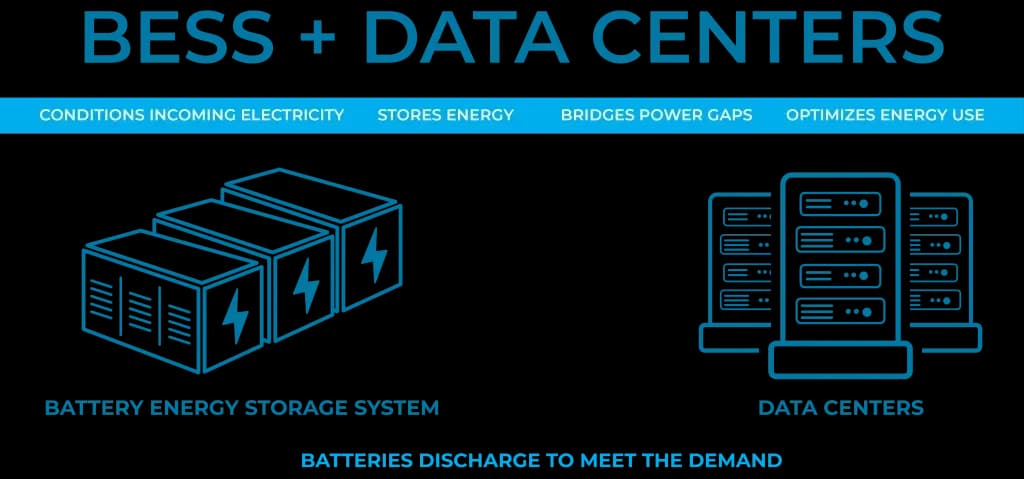
A behind-the-meter battery system charges gradually from the available grid connection during periods of lower demand and discharges to supplement supply when the data centre's load exceeds what the connection alone can deliver. This load-shifting flattens the peak demand the facility places on the local network, allowing a data centre to operate at a scale its raw grid connection could not otherwise support. The battery absorbs the difference between the steady import the grid can provide and the variable, spiky load the facility actually draws.
This turns a constrained grid connection into a workable power supply. A site that could never secure a connection sized for its full peak demand can instead secure a smaller connection and let the battery handle the peaks, bridging the facility into operation years before a full connection would arrive. When the grid connection is eventually upgraded, the same battery assets transition to other value streams, providing backup, grid services, and energy cost optimisation rather than being stranded.
Co-Location with Generation
The most complete behind-the-meter configurations pair storage with on-site generation, solar, wind, or gas, creating an integrated microgrid that can carry a substantial share of the facility's load independently of the grid. The battery firms the variable output of renewable generation and bridges the gaps, while the EMS coordinates every source against the data centre's real-time demand. This is where a data centre power system stops being a collection of equipment and becomes an orchestrated system, and where the control layer becomes decisive.
What European Regulation Now Requires
Behind-the-meter power for data centres is no longer only a workaround for connection queues. In parts of Europe it has become a regulatory requirement, which sharply raises the importance of getting the on-site energy architecture right.
Ireland has moved furthest. Following a de facto moratorium on data centre connections, the regulator's framework now requires new data centres to install on-site dispatchable generation or storagematching their full grid import capacity, and to source 80% of annual demand from additional Irish renewables over a defined glide path. In effect, a new Irish data centre must be able to power itself. That transforms the on-site energy system from a temporary bridge into permanent, mandated infrastructure that must operate reliably for the life of the facility.
Other regulatory pressures compound the picture. Germany's energy efficiency law imposes a hard power usage effectiveness ceiling on new data centre builds, the EU Energy Efficiency Directive mandates energy reporting, and planning authorities are increasingly hostile to diesel backup on emissions grounds — one refused UK data centre application in 2026 turned on campaigners arguing that diesel backup at scale could equal the emissions of tens of thousands of idling cars. Battery storage is the clean alternative that satisfies both the reliability requirement and the emissions scrutiny, but only if it is operated to the standard critical infrastructure demands. The emissions dimension connects to the lifecycle considerations in PowerKonnekt's guide to the carbon footprint of battery storage.
The AI Load Problem: Why Data Centre Power Is Uniquely Demanding
Data centres are not ordinary loads, and AI data centres are the most demanding of all. The power they draw is exceptionally sensitive to interruption and exceptionally volatile in profile, and both characteristics stress a battery system in ways that ordinary commercial load does not.
Interruption intolerance.Even a brief power interruption can disrupt an AI training run representing enormous computational cost, corrupt data, or take critical services offline. Data centres have always depended on uninterruptible power supplies to bridge the milliseconds between a grid failure and backup generation starting. A battery system supporting a data centre must deliver that same seamless continuity, holding the voltage and frequency reference through any disturbance so the load never sees an interruption. This is the seamless-transfer capability that separates a true microgrid from a backup generator, explained in the microgrid guide.
Load volatility.AI workloads produce power draws that ramp up and down far more sharply than traditional computing. A training cluster can swing between near-idle and full draw in seconds as workloads start and stop, producing a spiky, unpredictable demand profile. The battery system must absorb these swings in real time to present a smooth, manageable load to the grid connection, and to prevent the volatility from destabilising the on-site power system. This demands a control layer operating on a fast enough cycle to track the swings as they happen, not after.
These two demands, absolute reliability and real-time load smoothing, are what make data centre storage a control problem before it is a hardware problem. The battery capacity provides the energy; the EMS decides, continuously and in milliseconds, how to deploy it against a load that is both unforgiving and erratic.
The EMS is what turns a constrained grid connection plus batteries plus optional on-site generation into a coherent power system that behaves like infrastructure; smoothing volatile AI load, bridging grid disturbances without interruption, managing state of charge so backup capacity is always available, and coordinating multiple energy sources as one. A behind-the-meter system with capable hardware and an inadequate control layer will bridge the connection gap on paper but fail the reliability standard in practice. For a load as intolerant of interruption as an AI data centre, the control layer is not a component of the solution. It is the solution.
The EMS Role in Data Centre Power Systems
A data centre behind-the-meter power system asks the energy management system to do several demanding things at once, on the timescale critical infrastructure requires.
Real-time load smoothing.The EMS continuously measures the facility's volatile draw and dispatches the battery to flatten it, presenting a stable load to the grid connection and preventing spikes from exceeding the connection's capacity. This is peak shaving applied to an exceptionally spiky load, and it is what allows a small connection to support a large facility. The underlying demand-management mechanism is covered in PowerKonnekt's guide to peak shaving.
Seamless islanding and backup.If the grid connection fails, the EMS must transition the facility to islanded operation without interruption, holding the reference through the disturbance so the servers never see a gap. It must then manage the islanded system, coordinating storage and any on-site generation, until the grid returns, and resynchronise cleanly on reconnection.
State-of-charge and reserve management.The battery cannot be fully committed to load smoothing if doing so leaves no reserve for a grid failure. The EMS must continuously balance the energy used for peak management against the reserve held for backup, ensuring the facility is never exposed. This is a hard real-time constraint that a fixed schedule cannot satisfy.
Multi-source coordination and future value.The EMS coordinates grid import, battery, and on-site generation as a single system, and when the full grid connection eventually arrives, it redirects the battery assets to grid services, energy arbitrage, and cost optimisation so they continue earning rather than sitting idle. The revenue-stacking logic is the same as covered in PowerKonnekt's guide to energy arbitrage.
Frequently Asked Questions
Why do data centres need battery storage?
Data centres need battery storage for two converging reasons. First, grid connection queues in Europe run seven to ten years while data centres are built in under two, so behind-the-meter storage bridges the gap by allowing a facility to operate on a constrained connection with the battery handling peaks. Second, AI workloads are intolerant of interruption and highly volatile, and storage provides both the uninterruptible continuity and the real-time load smoothing that these workloads require.
What does behind-the-meter storage mean for a data centre?
Behind-the-meter storage is a battery system installed on the data centre's own side of the grid meter, charging from the available connection and discharging to supplement supply during peak demand. It flattens the facility's peak draw on the local network, allowing a data centre to operate at a scale its raw grid connection could not otherwise support, and bridging it into operation years before a full connection would be available.
How fast can battery storage be deployed compared to a grid connection?
Utility-scale battery systems are commonly deployed in six to eighteen months, and containerised behind-the-meter systems can be operational faster, particularly on previously developed sites. This compares with grid connection timelines of seven to ten years in Europe's major data centre clusters. Speed-to-power is the decisive advantage storage offers data centre developers racing to energise sites.
Do European regulations require data centres to have on-site storage?
Increasingly, yes. Ireland now requires new data centres to install on-site dispatchable generation or storage matching their full grid import capacity, and to source 80% of annual demand from additional renewables. Other jurisdictions impose efficiency ceilings, energy reporting, and planning restrictions that push data centres toward clean on-site power. Behind-the-meter storage is moving from workaround to regulatory requirement in parts of Europe.
Can a data centre battery system provide value after the grid connection arrives?
Yes. Once a full grid connection is available, the same battery assets transition from bridging capacity to other value streams: providing backup power, participating in grid-service and frequency-regulation markets, and optimising energy costs through arbitrage and time-of-use management. A well-designed system with a capable EMS avoids the batteries becoming stranded assets, keeping them productive across the facility's life.
Why is the EMS critical for data centre storage?
Data centre load is uniquely demanding: intolerant of interruption and highly volatile. The EMS is what smooths the volatile AI load in real time, bridges grid disturbances without any interruption to the servers, manages state of charge so backup capacity is always available, and coordinates grid, battery, and on-site generation as one system. Capable battery hardware with an inadequate control layer will fail the reliability standard a data centre requires; the EMS is what makes co-located storage behave like infrastructure.
How PowerKonnekt Approaches This
The behind-the-meter power system a data centre needs is precisely the kind of orchestrated, multi-source, reliability-critical microgrid the PowerKonnekt EMS is built to run. The platform coordinates grid import, battery storage, and on-site solar, wind, or generation as a unified system, dispatching each against the facility's real-time demand on the20-millisecond control loopthat fast load smoothing and seamless islanding require. Itspeak limitingfunction flattens volatile draw to keep the facility within its grid connection capacity, while continuous monitoring and safety functions protect the load through any disturbance.
Microgrid capability is native to the platform, enabling a data centre to island seamlessly when the grid fails and continue operating from local resources without interruption. The EMS manages the state-of-charge reserve so backup capacity is always available even while the battery is actively smoothing load, executes the islanding transition through millisecond-level monitoring, and resynchronises cleanly when the grid returns. This is the same grid-forming and islanding capability PowerKonnekt deploys at utility scale, described in the grid forming guide.
The brand-agnostic architecture is particularly valuable for data centre projects, which are assembled at speed from whatever hardware can be procured on the developer's timeline. PowerKonnekt integrates battery systems, power conversion equipment, and generation from any manufacturer through its protocol stack, so a developer racing to energise a site is never constrained to a single vendor's hardware by the choice of control system. And when the full grid connection eventually arrives, the EMS redirects the battery assets to grid services, arbitrage, and cost optimisation, ensuring the bridge investment keeps earning across the facility's life rather than becoming a stranded asset.
For data centre developers, colocation providers, and hyperscalers evaluating behind-the-meter power strategy, see the utility-scale EMS solutions and the C&I EMS solutions, or contact the technical team at powerkonnekt.com/contact to discuss the control architecture for a specific site's power system.